X
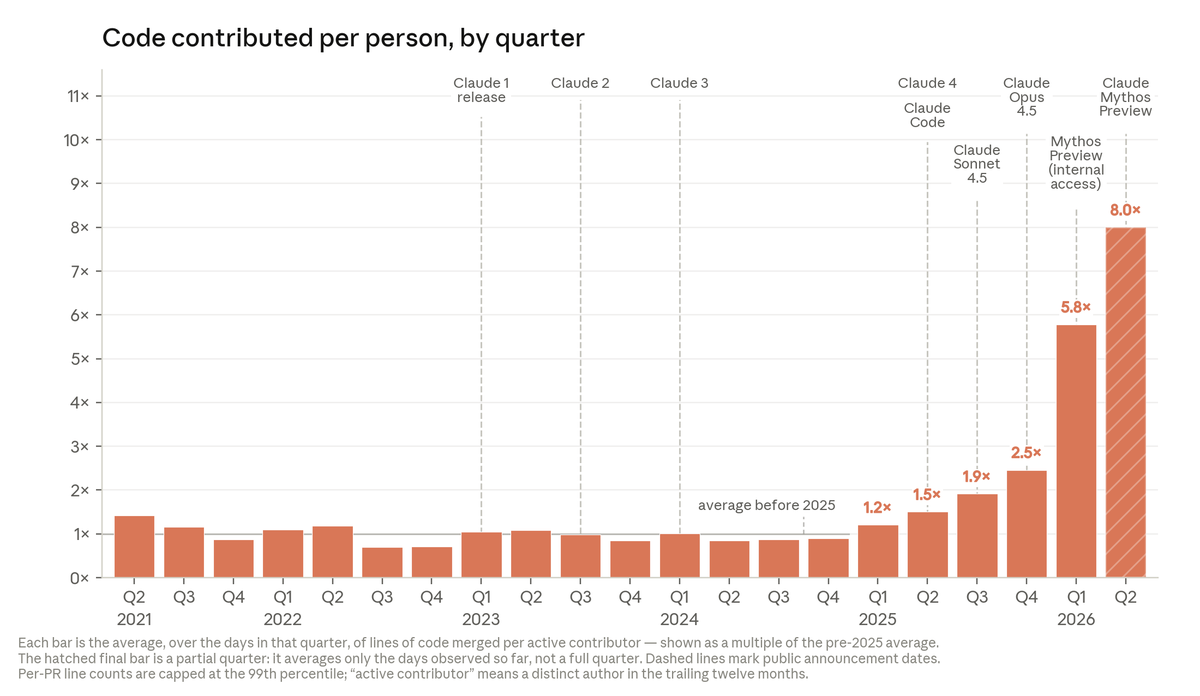
Today, Anthropic engineers on average ship 8x as much code per quarter as they d
X · AnthropicAI · 2026-06-04
Anthropic engineers now ship 8x more code per quarter compared to their average output in 2021-2025. This acceleration in engineering productivity reflects a significant increase in the pace of code deployment and iteration at the organization. The development demonstrates shifting dynamics in AI company velocity and technical advancement.
Detailed Analysis
Anthropic publicly claimed in mid-2026 that its engineers now ship, on average, eight times as much code per quarter as they did during the 2021–2025 period, pointing to AI-assisted development as the primary driver of the productivity surge. The announcement, made via the company's official social media account and accompanied by a linked report, drew significant attention across the technology and investment communities. Commenters engaging with the post introduced a separate figure of 52x, which appears to reference a metric from the linked document distinct from the headline 8x average — potentially measuring a specific team, workflow, or output type rather than an engineer-wide mean. The discrepancy between the two numbers suggests Anthropic may be reporting multiple dimensions of productivity gain simultaneously, with the 52x figure representing a more concentrated or specific acceleration within particular engineering functions.
What makes the development analytically significant is not merely the magnitude of the numbers but, as several observers noted, the shape of the underlying curve. A trajectory described as moving from roughly baseline to 3x to 52x in under three years does not resemble incremental tooling improvement; it more closely resembles a phase transition in how software engineering work is structured. This framing aligns with the broader argument that AI is increasingly writing the evaluation systems, tooling, and scaffolding used to build subsequent AI models — what one commenter described as "compounding" rather than a discrete singularity event. If Claude or similar models are now generating the infrastructure that reduces the cost of building the next generation of models, the productivity figures at Anthropic may be self-reinforcing rather than plateau-bound.
The announcement also carries implications for how competitive advantage in the AI sector is understood. Commenters with investment perspectives argued that productivity figures of this magnitude signal a structural shift in where industry moats reside — moving away from proprietary model weights and toward accumulation of high-quality training data, internal tooling, and engineering velocity. This interpretation is consistent with the broader industry dynamic of 2025–2026, in which several frontier AI labs have reported dramatic internal productivity improvements as a direct consequence of deploying their own models as development assistants. Anthropic's disclosure, whether or not the precise figures are independently verifiable, positions the company as a beneficiary of this feedback loop at meaningful scale.
The reaction to the announcement was not uniformly positive. At least one user directly contradicted the narrative of reliability by reporting persistent failures caused by Claude-generated code, describing a pattern of using paid API access to debug regressions introduced by the model itself — an irony that highlights a tension between aggregate productivity metrics and individual user experience. Such complaints are a recurring feature of AI productivity announcements, where enterprise-level throughput gains can coexist with reliability concerns that disproportionately affect individual developers or smaller-scale deployments. The gap between headline statistics and ground-level experience represents an ongoing credibility challenge for AI companies making sweeping productivity claims based on internal data.
Taken together, Anthropic's 8x engineering productivity claim represents one of the more concrete quantitative assertions a major AI lab has made about the internal impact of its own technology — and it arrives at a moment when the industry is broadly debating whether AI-assisted development constitutes a qualitative shift in software production or a more modest acceleration. The figures, if sustained, would support the view that frontier AI labs are entering a period of compounding internal advantage, where each generation of model tooling accelerates the construction of the next, creating structural separation from competitors who lack both the models and the institutional knowledge to deploy them at this depth of integration.

Don't Miss a Deploy
Claude moves fast. Get the signal — no noise — straight to your inbox every morning.