Detailed Analysis
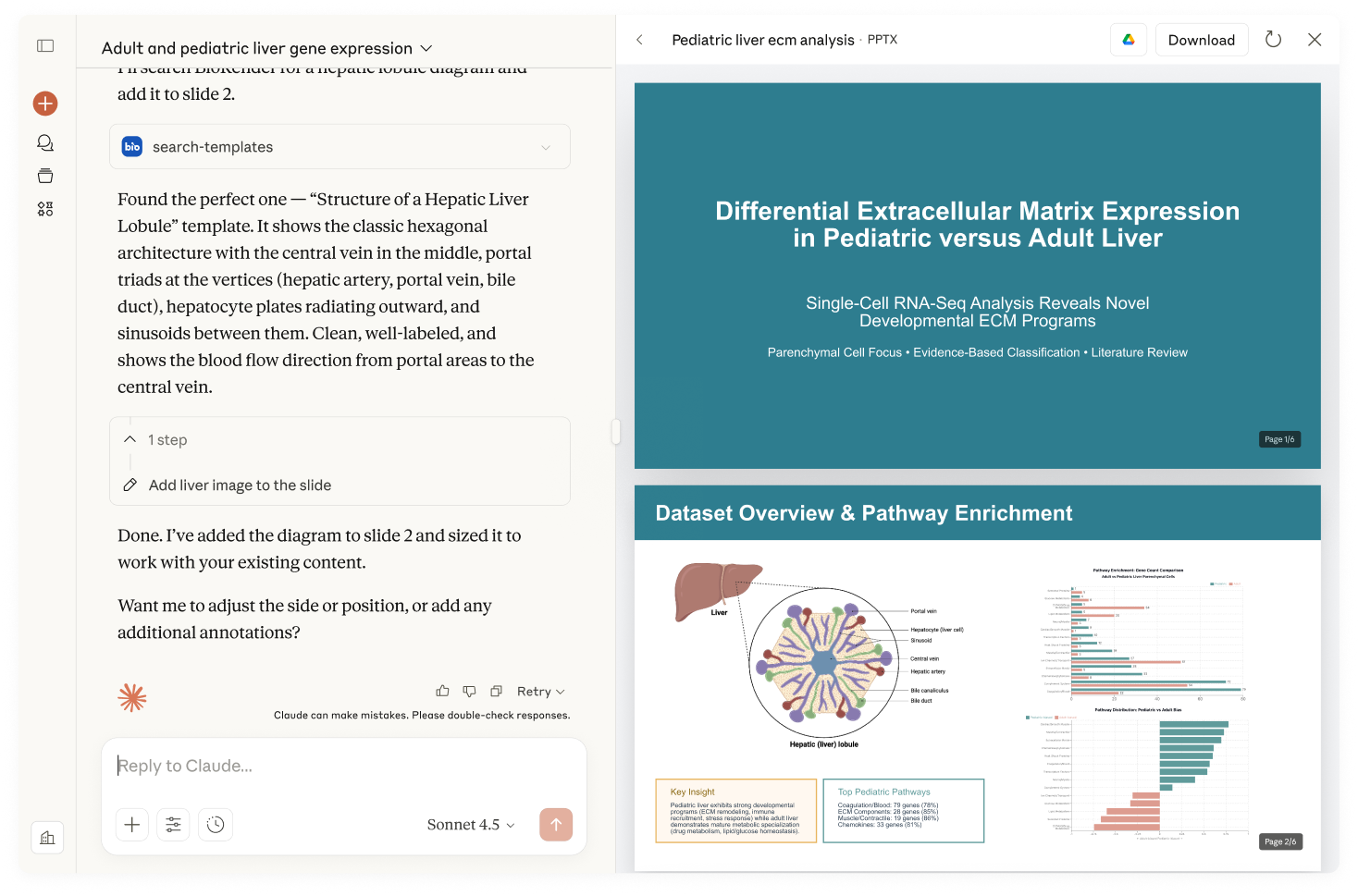
Claude Science represents Anthropic's formal entry into the specialized scientific research software market, positioning its Claude AI system as an integrated workbench capable of spanning the entire life sciences product development lifecycle — from early-stage discovery through clinical operations and regulatory affairs. The application, currently available in beta for macOS 13 and later as well as Linux x64, allows researchers to connect a substantial array of domain-specific data sources and platforms through a connector architecture, querying them in natural language and receiving responses with source citations. Supported connectors include Benchling for R&D platform data, 10x Genomics for single-cell and spatial transcriptomics, PubMed and bioRxiv/medRxiv for literature access, ChEMBL for bioactive compound repositories, ClinicalTrials.gov for clinical study registries, and Medidata for clinical trial solutions management, among others. Notably, the application also supports local computation on the user's machine, a meaningful capability for researchers working with sensitive or proprietary biological data.
The connector ecosystem Claude Science has assembled reflects a deliberate effort to address the fragmented tooling reality that characterizes modern biomedical R&D. Researchers in drug discovery and clinical development routinely toggle between electronic lab notebooks, genomics pipelines, literature databases, regulatory filing systems, and clinical data platforms — each siloed and requiring distinct expertise to interrogate. By enabling natural language queries that span Benchling notebooks, Synapse.org datasets, PubMed abstracts, and ClinicalTrials.gov registries within a single interface, Claude Science aims to collapse this context-switching overhead. The inclusion of ToolUniverse, which surfaces more than 600 vetted scientific tools, further suggests that Anthropic is targeting not merely literature synthesis but genuine computational research workflows, including hypothesis testing and iterative analysis cycles.
The technical use cases highlighted in the documentation — single-cell RNA-seq analysis, CRISPR screen design, phylogenetic reconstruction, protein structure prediction, cheminformatics, and genomics/proteomics pipelines — situate Claude Science squarely within the domain of computational biology and bioinformatics. These are not simple summarization tasks; they involve multi-step analytical pipelines built on established frameworks such as scverse and Bioconductor. Anthropic's claim that Claude Science can take researchers from raw count matrices to publication-ready figures with full provenance tracking signals an ambition to serve as an end-to-end research platform rather than a supplementary chatbot. The emphasis on traceability and source citations throughout the documentation also speaks directly to the reproducibility and audit requirements that govern pharmaceutical development and regulatory submissions.
Claude Science enters a competitive landscape that includes emerging AI research platforms from major cloud providers and dedicated life sciences AI companies, but Anthropic's approach is distinctive in its emphasis on connector interoperability and local execution rather than proprietary data ingestion. The partnership list — spanning academic infrastructure (Synapse.org, bioRxiv), commercial R&D platforms (Benchling, 10x Genomics), and clinical data leaders (Medidata) — suggests a strategy of embedding Claude into existing research workflows rather than displacing them. The access model, requiring Pro, Max, Team, or Enterprise subscriptions with organization-level enablement for teams, positions Claude Science as an enterprise life sciences product with managed deployment characteristics. This trajectory aligns with a broader industry movement in which foundation model providers are building vertical-specific applications to translate general AI capability into domain-validated, compliance-aware tools that can realistically operate within regulated industries such as pharmaceuticals and clinical research.
 Read original article →