Detailed Analysis
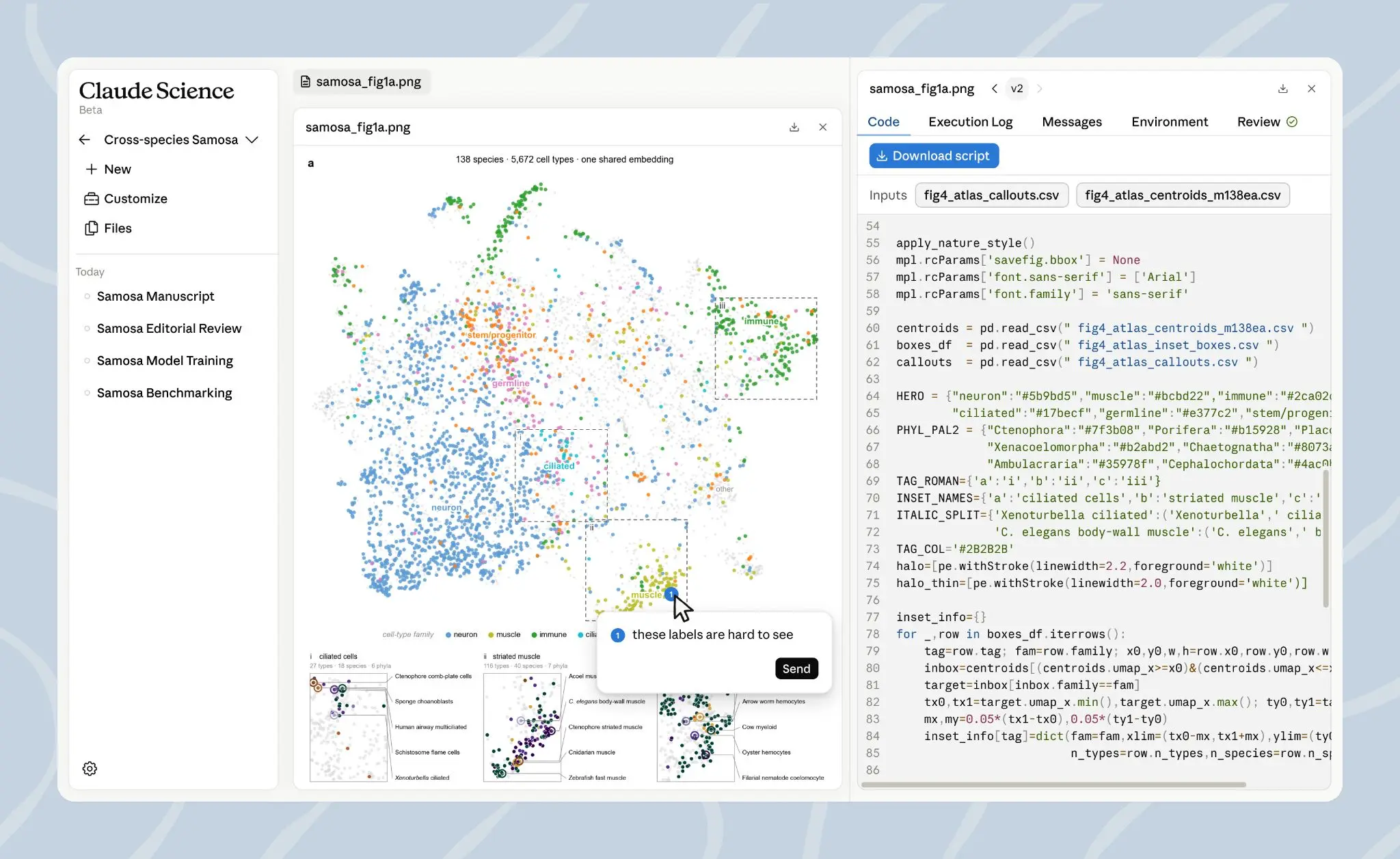
Anthropic has introduced Claude Science, a specialized AI workbench designed to consolidate and accelerate scientific research workflows across the life sciences and adjacent domains. Announced as a beta release for Claude Pro, Max, Team, and Enterprise subscribers, the platform integrates more than 60 curated skills and database connectors pre-configured for disciplines including genomics, single-cell analysis, proteomics, structural biology, and cheminformatics. Rather than replacing individual tools, Claude Science functions as a unified research environment that bridges fragmented resources—PubMed, Jupyter, R, HPC cluster terminals, and databases such as UniProt, PDB, Ensembl, ClinVar, and ChEMBL—into a single interface where scientists can conduct literature analysis, run multi-step computational pipelines, generate figures, and prepare manuscripts. The platform integrates with NVIDIA's BioNeMo Agent Toolkit, providing native access to foundation models including Evo 2, Boltz-2, and OpenFold3.
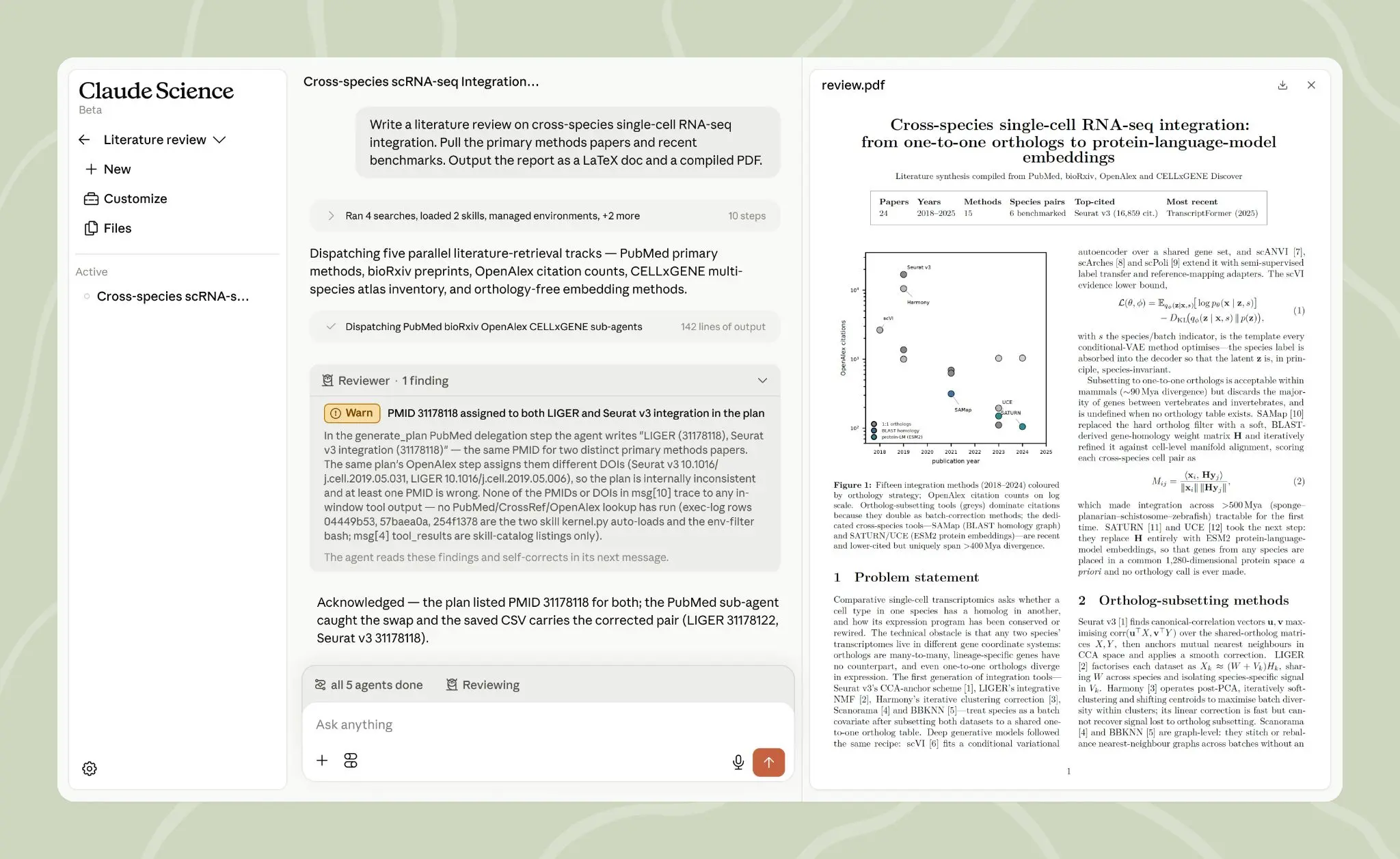
A central architectural feature of Claude Science is its multi-agent design, in which a generalist coordinating agent delegates to specialist agents capable of querying heterogeneous scientific databases and running domain-specific analyses. A dedicated reviewer agent operates in parallel, checking citations, validating calculations, and flagging figures that diverge from their underlying code—a mechanism directly addressing the reproducibility and auditability problems that have long afflicted computational science. Every output includes the exact code and execution environment used to produce it, a plain-language description of methodology, and a full message history, allowing researchers to trace results months after they were generated. The system also supports session forking, enabling scientists to compare analytical approaches without sacrificing prior work.
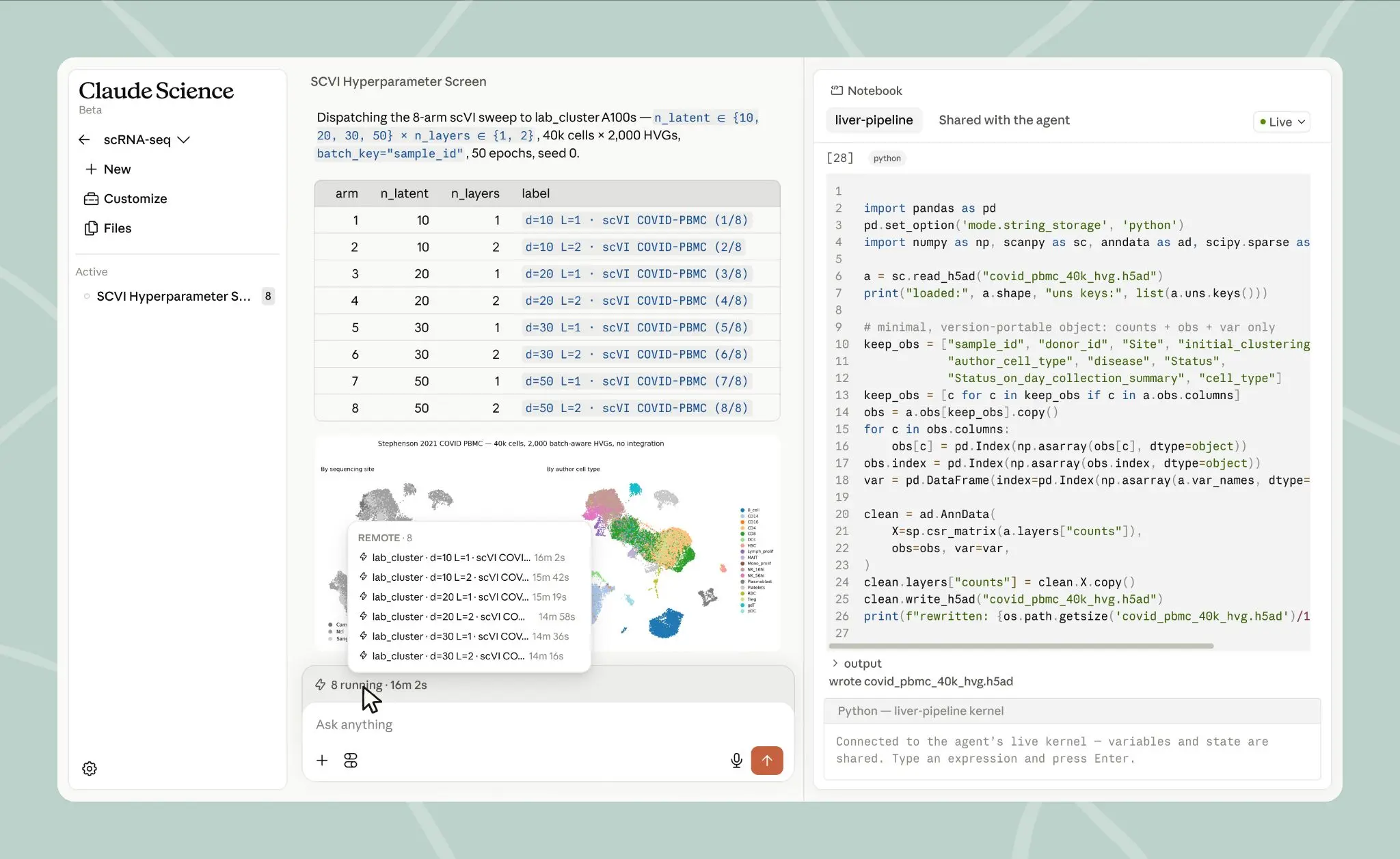
The compute management capabilities of Claude Science address one of the most persistent friction points in quantitative research. Large analyses—protein folding, large-scale genomics pipelines—typically require researchers to manually configure jobs, submit them to clusters, monitor execution, and retrieve results. Claude Science automates this process end-to-end, drafting execution plans, requesting user approval before consuming new resources, and scaling from single-GPU jobs to hundreds using either the lab's existing HPC infrastructure over SSH or Modal for on-demand cloud compute. Critically, because agents maintain context within a running session, large datasets need only be loaded once, and sensitive data never leaves the researcher's own infrastructure. Only the contextual information necessary for each analytical step is transmitted to Claude's underlying models, a design that directly addresses data governance concerns common in clinical and proprietary research settings.
The launch of Claude Science reflects a broader competitive race among AI developers to move beyond general-purpose assistants toward domain-specific, tool-integrated agents capable of conducting autonomous multi-step work. Anthropic first signaled this strategic direction with its life sciences initiative in late 2025, and Claude Science represents its most substantive realization of that vision to date. The platform's emphasis on reproducibility, auditability, and integration with existing trusted tools and pipelines positions it as a response to scientific community concerns about opacity in AI-generated research—a concern that has grown as AI-produced figures and analyses have begun appearing in peer-reviewed literature. By embedding a reviewer agent and full provenance tracking into the core workflow, Anthropic is attempting to make auditability a structural property of the product rather than an afterthought.
The broader significance of Claude Science lies in its potential to compress the time between scientific hypothesis and validated result, particularly in biology and drug discovery where data fragmentation and computational complexity are most acute. By connecting natively to models like Evo 2 and Boltz-2—tools for genomic and protein structure prediction—Claude Science positions itself at the intersection of foundation model capabilities and experimental research infrastructure. Whether the platform can deliver on the promise of dramatically accelerating scientific discovery will depend heavily on how well the multi-agent coordination handles edge cases in real research environments, and on the scientific community's willingness to trust and validate AI-generated analyses. The beta release strategy suggests Anthropic is prioritizing iterative refinement based on actual researcher feedback before making broader claims about the platform's impact on the pace of discovery.

 Read original article →