Detailed Analysis
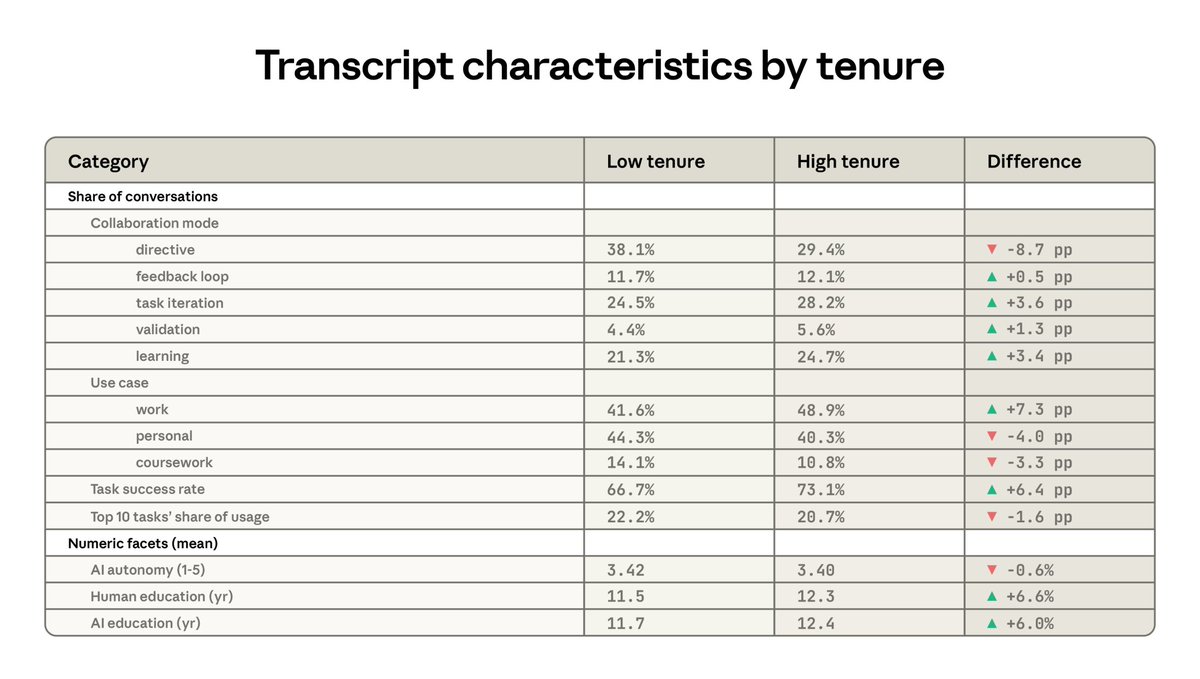
The Anthropic Economic Index has released new findings examining how user behavior with Claude evolves as individuals gain more experience with the system. The research identifies several key behavioral shifts among longer-term users: they are more likely to iterate carefully and collaboratively with Claude rather than delegating tasks wholesale, they attempt higher-value and presumably more complex tasks, and they receive more successful responses as a result. This pattern suggests a meaningful learning curve in how people interact with AI assistants — one that has measurable consequences for the quality and nature of outputs produced.
The finding that experienced users are *less* likely to grant Claude full autonomy, not more, is particularly notable and somewhat counterintuitive. One might expect that trust built over time would lead users to delegate more freely, but the data suggests the opposite: familiarity breeds a more deliberate, iterative style of engagement. This implies that sophisticated users come to understand the value of maintaining their own judgment and oversight in the loop, treating Claude as a collaborative tool rather than an autonomous agent. This has significant implications for how AI companies should think about user education — the goal may not be to maximize automation, but to cultivate informed, engaged partnership.
From a broader AI development perspective, this research connects to ongoing industry debates about the appropriate division of labor between humans and AI systems. The finding that careful human-AI collaboration yields better outcomes than full autonomy aligns with arguments made by AI safety researchers who emphasize the importance of "human-in-the-loop" design. It also provides empirical grounding for Anthropic's publicly stated philosophy around building AI that augments human capability rather than replacing human judgment outright.
The Anthropic Economic Index itself represents a notable institutional effort to systematically study the economic and behavioral dimensions of AI adoption. By tracking how Claude is actually used over time — rather than relying solely on benchmark performance — Anthropic is generating a form of real-world usage data that is increasingly rare and valuable in the AI industry. This longitudinal approach allows for insight into skill acquisition, task complexity, and success rates that static capability evaluations cannot capture, and positions Anthropic as a contributor not just to AI capability research but to the emerging field of AI economics and human-computer interaction at scale.
 Read original article →