Detailed Analysis
Anthropic's $10 million CAD commitment to Canadian research institutions represents a significant investment in the country's AI ecosystem, one that explicitly acknowledges Canada's foundational role in the development of modern deep learning. The funding will flow to a broad coalition of partners: the three major regional AI institutes (Amii in Edmonton, Mila in Montréal, and the Vector Institute in Toronto), pediatric and mental health research centers (CHEO and CAMH), and several universities (Université Laval, University of Toronto, and University of Saskatchewan). Rather than simple cash grants, much of the support comes in the form of Claude API credits and access, directing recipients toward specific research applications ranging from reinforcement learning and AI safety to computational psychiatry, low-resource language modeling (including Quebec French and Indigenous languages), and biomedical research. This structure serves a dual purpose common to corporate AI research investments: it advances genuinely valuable academic work while also embedding Claude as the default tool within influential research communities that shape future talent and policy.
The historical framing in the announcement is not incidental. Toronto, Montréal, and Edmonton were among the few places that kept neural network research alive during the "AI winter" of the 1980s and 1990s, and the resurgence of deep learning in the early 2010s—driven by GPU-accelerated training—was substantially a Canadian achievement, associated with figures like Geoffrey Hinton, Yoshua Bengio, and Richard Sutton. Anthropic co-founder Chris Olah's statement that he was "formed by that culture" underscores how deeply Anthropic's own safety-focused research agenda traces back to this Canadian lineage. By funding Amii, Mila, and Vector specifically, Anthropic is investing in institutions that not only pioneered core AI techniques but also became early centers for AI safety and responsible-AI research, a lineage Anthropic frequently cites as central to its own mission and identity as a company founded on the premise that capable AI systems must be developed carefully.
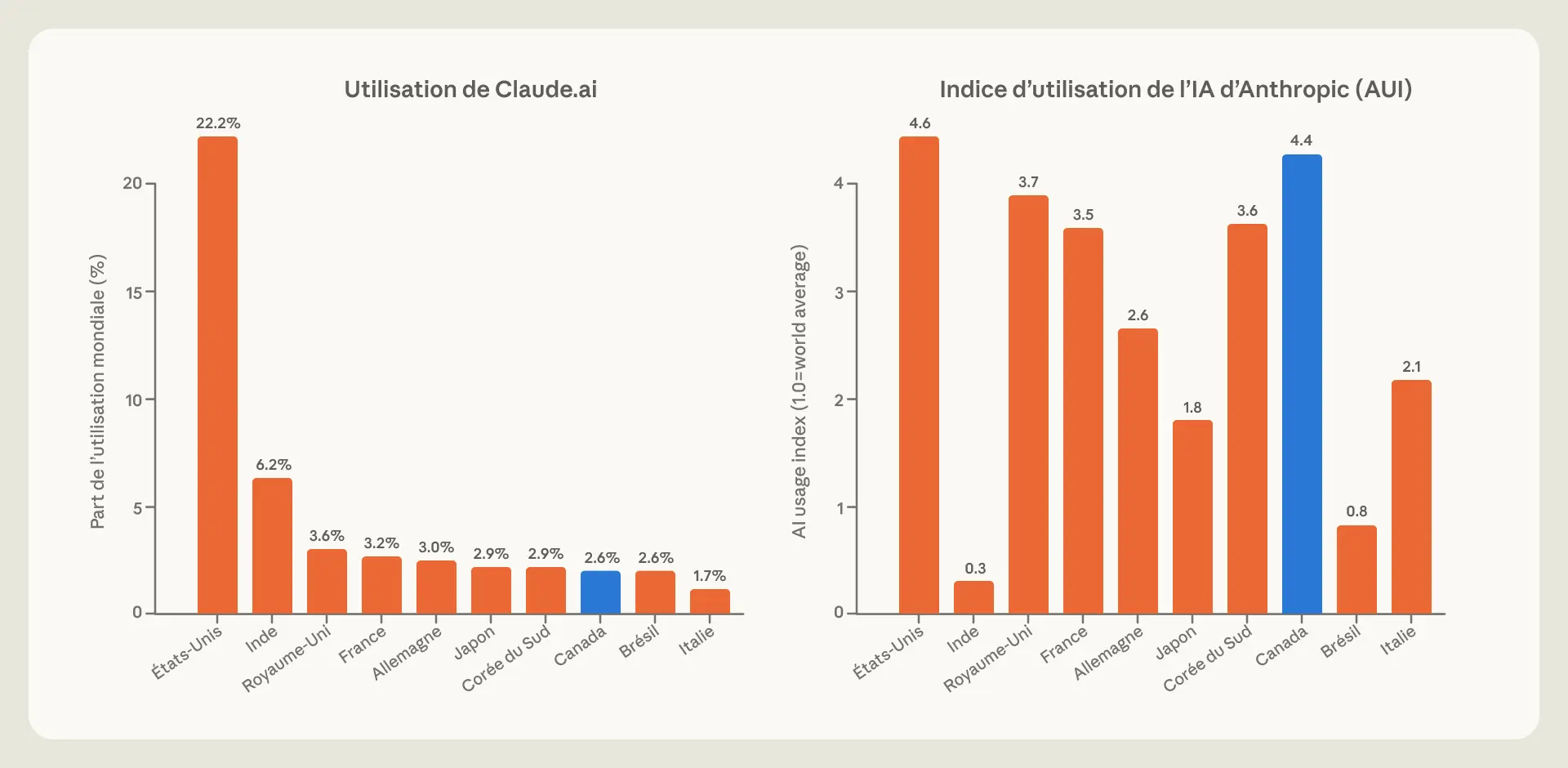
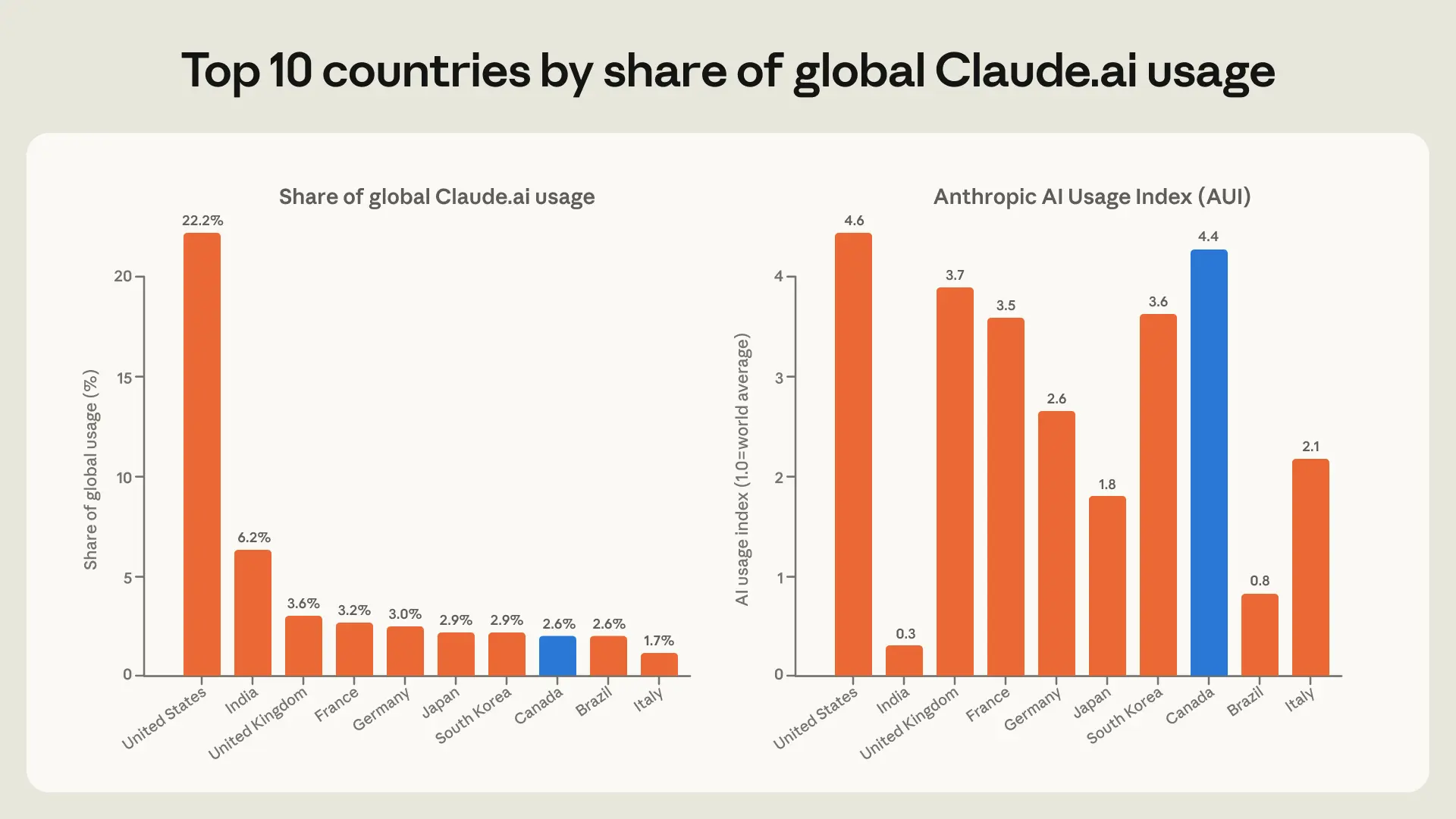
The announcement also includes Anthropic's first Canada-specific country brief from its Economic Index, an ongoing research effort that tracks real-world Claude usage patterns to understand how AI is diffusing through labor markets and economies. The data shows Canada ranks eighth globally in raw Claude.ai usage but second when adjusted for population size via Anthropic's Usage Index, trailing only the United States in per-capita adoption. This economic research initiative has become a signature piece of Anthropic's public communications strategy, serving simultaneously as market intelligence, a policy tool for engaging governments on AI's labor market effects, and evidence supporting Anthropic's narrative that it takes a data-driven, transparent approach to understanding AI's societal impact.
Extending the Anthropic for Startups program to founders affiliated with Amii, Mila, and Vector—offering at least $5,000 USD in credits to potentially hundreds of companies—further illustrates Anthropic's strategy of building ecosystem loyalty at the earliest stages of company formation. This mirrors similar moves by OpenAI, Google, and Microsoft, all of which have pursued academic and startup partnerships as a low-cost, high-leverage way to seed developer ecosystems, secure research talent pipelines, and normalize their respective models as default infrastructure. In this context, Anthropic's Canadian investment fits into a broader pattern among frontier AI labs: leveraging philanthropic-style research funding and cloud credits not merely as goodwill gestures but as strategic instruments for competitive positioning, talent recruitment, and soft-power influence over how AI safety and governance norms are established in leading research hubs outside the United States.

 Read original article →