Detailed Analysis
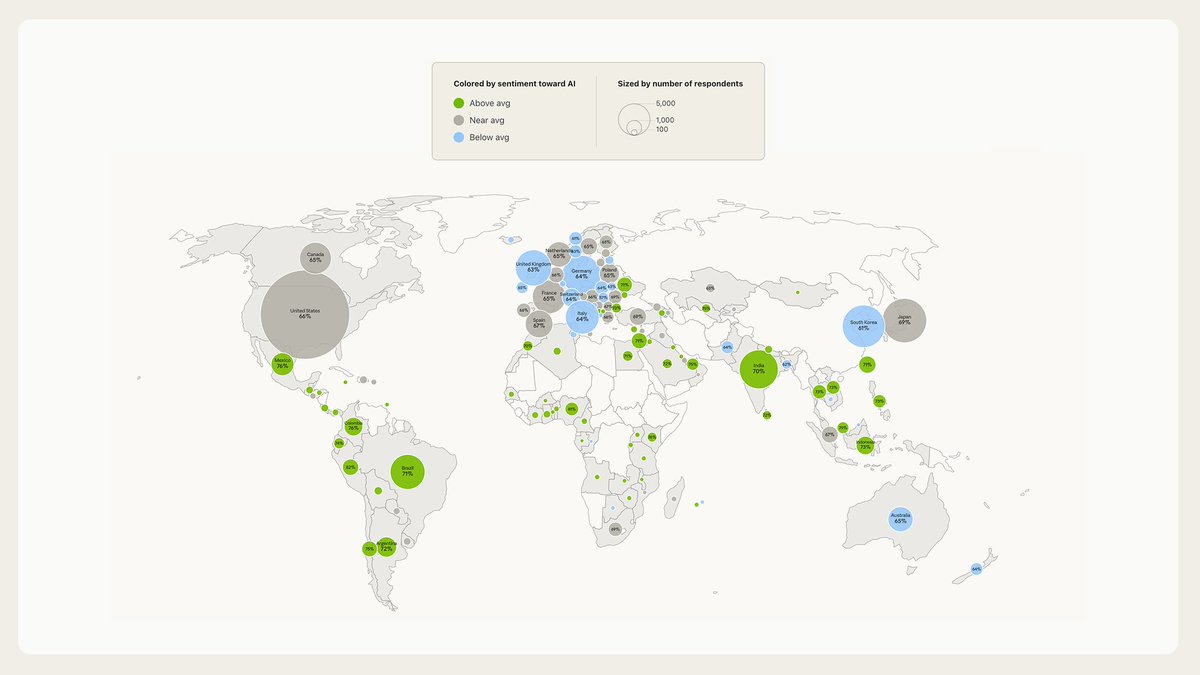
A global survey has found that 67% of people hold a positive view of artificial intelligence, though that optimism is distributed unevenly across regions. Enthusiasm runs notably higher in South America, Africa, and Asia than in Europe or the United States, suggesting that geography, economic context, and exposure to AI's potential upside shape public sentiment in meaningful ways. Separately, Anthropic conducted what appears to be one of the largest qualitative studies of its kind, gathering responses from more than 81,000 Claude users in a single week. That study, which combined broad survey data with deep qualitative interviews, surfaced recurring user hopes including more time, financial freedom, sharper professional output, and personal growth — with 81% of respondents already reporting some positive impact from AI use in their lives.
The regional divergence in AI optimism is significant and reflects well-documented patterns in technology adoption. In emerging economies across Africa, Southeast Asia, and Latin America, AI is frequently perceived as a leapfrogging technology — a means of bypassing entrenched infrastructure gaps in education, healthcare, and financial access. In contrast, wealthier Western nations carry heavier historical anxiety about automation's effects on labor markets, data privacy, and institutional trust, producing more cautious or ambivalent public attitudes. The consistent trio of fears identified across users — job displacement, misinformation, and existential risk — has remained stable since at least 2022, indicating that public concern is not diminishing even as AI capabilities accelerate rapidly.
The 81,000-response study represents a notable methodological commitment from Anthropic to grounding product and policy decisions in real-world user experience rather than synthetic benchmarks alone. The scale of the qualitative effort distinguishes it from typical Net Promoter Score surveys or usage telemetry, as it attempts to capture the texture of how people are integrating Claude into their lives and what psychological stakes they attach to that relationship. The study's findings — that users simultaneously want AI to make their work easier and fear AI will take their jobs — capture a duality that Anthropic and its competitors must navigate carefully as they scale deployment and refine model behavior.
The broader social thread surrounding the survey announcement also surfaces a sharp tension between Anthropic's research ambitions and its commercial execution. Numerous Claude subscribers publicly complained about usage limits, unexpected billing charges, unresponsive support, and pricing changes that they felt degraded the value of premium tiers like the Max plan. These complaints, surfacing in the same conversation as the positive survey data, underscore a recurring challenge in the AI industry: the gap between the aspirational narrative of democratizing intelligence and the operational friction users encounter at the product level. For Anthropic specifically, the juxtaposition of a landmark 81,000-person study on human AI hopes alongside a flood of unresolved billing disputes and hard usage caps points to the organizational scaling pressures that accompany rapid growth.
The survey data and user responses together reflect a broader industry-wide moment in which public expectations of AI are crystallizing faster than governance, product design, and support infrastructure can accommodate. The geographic optimism gap — with the Global South expressing more enthusiasm than Europe or North America — may also carry long-term strategic implications for where AI companies find their most receptive markets and where regulatory friction will be lowest. Anthropic's investment in large-scale qualitative research signals an awareness that model capability alone will not determine competitive differentiation; understanding and shaping user trust, at a cultural and individual level, is becoming as critical a variable as benchmark performance.
 Read original article →