Detailed Analysis
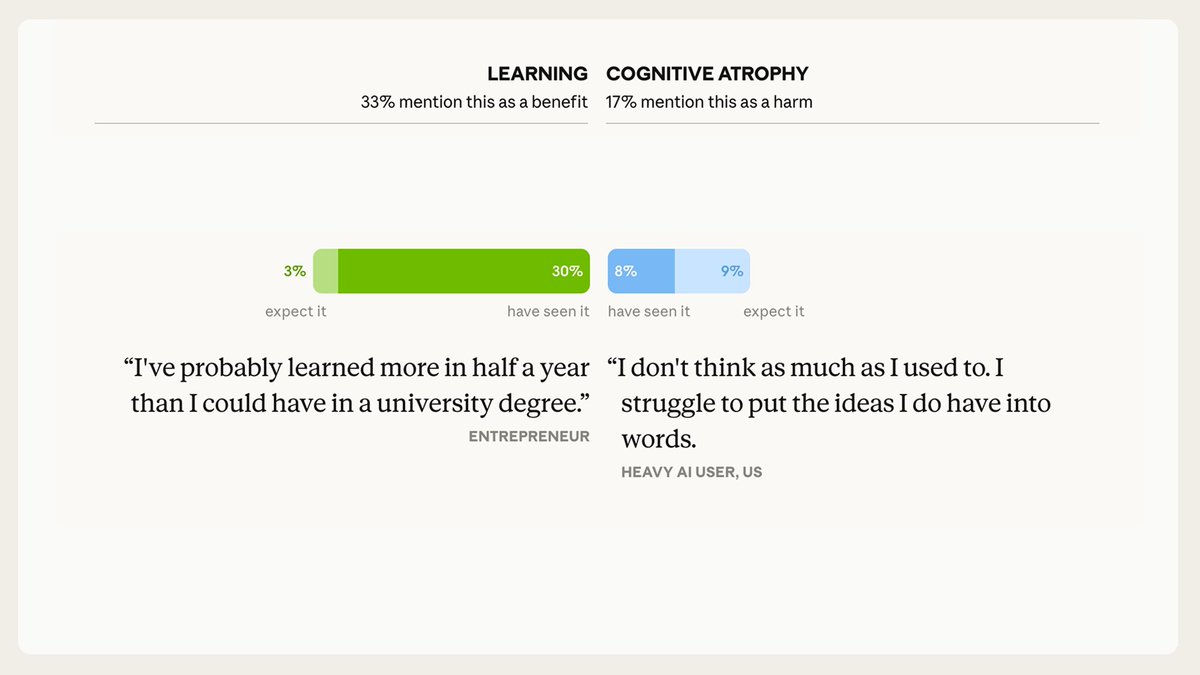
Anthropic conducted what appears to be one of the largest qualitative studies of AI users to date, gathering responses from over 81,000 Claude users globally within a single week. The central finding emerging from this research is a striking psychological duality: the people who derive the greatest benefits from AI in any given domain are simultaneously the most likely to harbor fears about what AI could cost them in that same domain. The study further distinguishes between the nature of benefits versus fears — benefits tend to be described in grounded, experiential terms drawn from actual use, while fears are more often anticipatory and speculative in character. This asymmetry between lived gain and imagined loss reveals something meaningful about how humans process transformative technology.
The public reaction on social media amplifies and validates the study's core thesis in real time. Multiple users simultaneously praise Claude's capabilities — citing its 200,000-token context window, its utility for coding and professional workflows, and its role in providing time savings and financial opportunity — while others in the same thread voice sharp frustrations about usage limits, pricing restructuring, and perceived reductions in value. One user captures the duality almost perfectly, joking that "81k responses and I bet half of them were 'make my job easier' and 'don't take my job'" — an observation that is simultaneously cynical and deeply accurate. The comment thread essentially enacts the study's findings: beneficiaries and critics are often the same people wearing different hats in different moments.
The scale and methodology of the study itself carries significance beyond its findings. Qualitative research at 81,000 respondents is unusual in both social science and industry contexts, where such studies typically involve far smaller samples due to the interpretive labor involved. Anthropic's ability to conduct this at scale — likely with AI-assisted analysis — signals a maturing approach to user research in the AI industry, moving beyond simple satisfaction surveys toward richer, more structured inquiry into how people emotionally and practically relate to these tools. The study's framing around hopes and fears also suggests Anthropic is deliberately positioning itself as a company that takes human psychology and societal impact seriously, not merely technical benchmarks.
The broader context of these findings lands at a moment of significant tension in the AI industry. Multiple users in the thread express frustration with recent changes to Claude's pricing tiers and usage limits — particularly a controversial decision to exclude third-party applications from discounted plans beginning in April 2026 — suggesting that the gap between what users hope AI will provide and what they fear it might extract financially is widening. This friction is not incidental to the study's findings; it illustrates precisely how benefit and fear can co-exist within the same product relationship. Users who have built genuine workflows around Claude's capabilities feel most exposed when the terms of access change, embodying the study's conclusion that deep utility and deep vulnerability travel together.
The study's implicit argument — that the most useful AI systems will be shaped not just by capability but by what people actually want, need, and worry about — represents a design philosophy that distinguishes Anthropic's public posture from competitors focused primarily on performance metrics. By surfacing the psychological landscape of its user base at scale, Anthropic is both gathering actionable product intelligence and making a broader claim about responsible AI development: that understanding human ambivalence toward these tools is not a soft concern but a foundational one. Whether this research translates into product decisions that address the usage limit frustrations and pricing grievances visible in the same thread remains an open question, but the study itself positions Anthropic as a company treating user psychology as a first-class input into how AI should be built and governed.
 Read original article →