Detailed Analysis
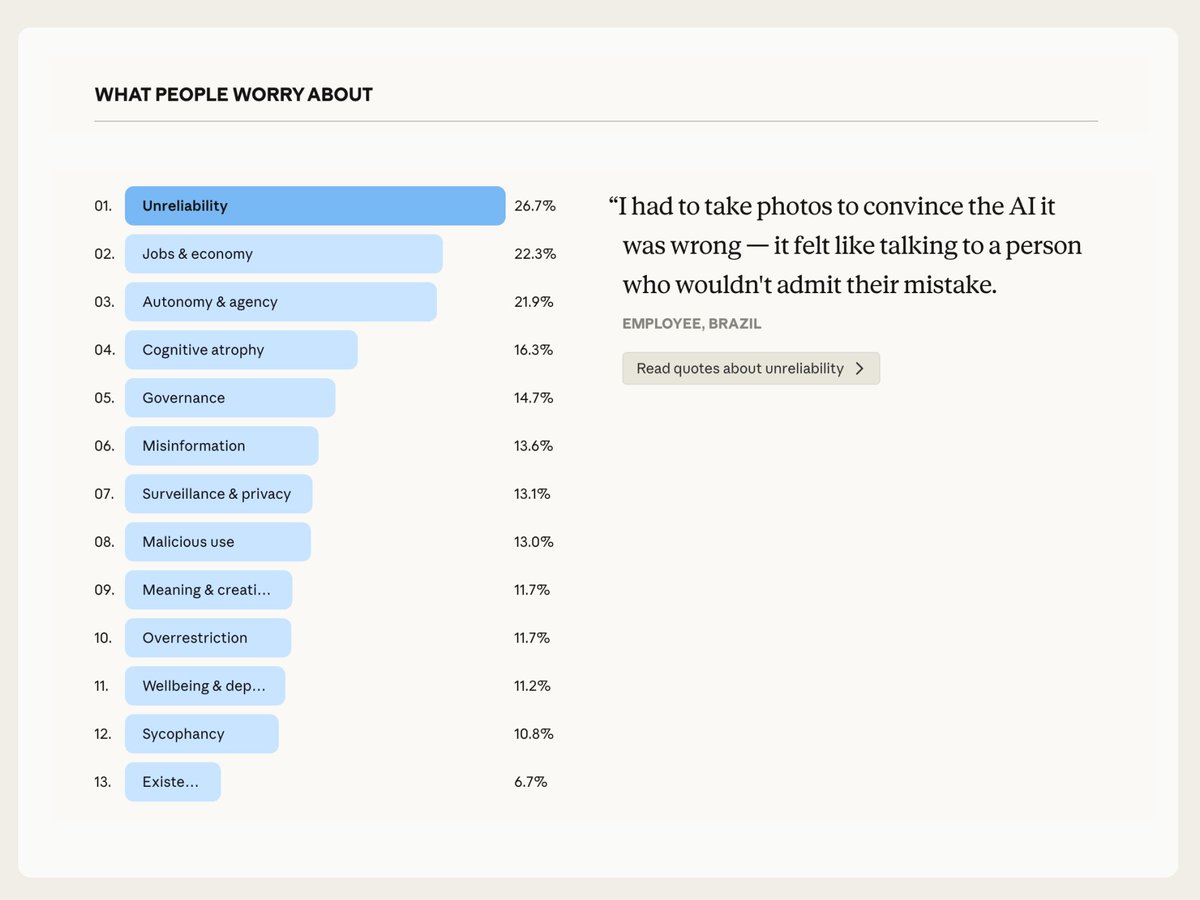
Anthropic conducted what appears to be the largest qualitative study of its kind, gathering over 81,000 responses from real Claude users globally within a single week, examining their hopes and fears surrounding artificial intelligence. The study's findings revealed that human hopes tended to cluster around a relatively small set of desires — more time, financial freedom, improved work performance, and personal growth — while concerns were notably more varied and dispersed. The three dominant fears identified were AI unreliability, economic and job displacement, and the erosion of human autonomy and agency. Most significantly, economic anxiety emerged as the strongest single predictor of overall AI sentiment, suggesting that how individuals perceive AI's threat to their livelihoods shapes their broader disposition toward the technology more than any other factor.
The scope and methodology of the study represent a meaningful departure from conventional AI opinion research. Rather than relying solely on traditional surveys, Anthropic incorporated deep qualitative interviews alongside quantitative responses, yielding a richer picture of user psychology. The 81,000-response figure, achieved in just one week, signals both the scale of Anthropic's active user base and the degree to which questions about AI's societal role have become genuinely urgent to ordinary people rather than just technologists or policymakers. The asymmetry between hopes and fears — few shared aspirations versus many diverse anxieties — reflects a pattern common in technology adoption cycles, where benefits are imagined in relatively universal terms while risks are perceived through highly individualized lenses shaped by profession, geography, and economic circumstance.
The thread surrounding the study's announcement also surfaces a parallel and telling story: widespread user frustration with Anthropic's own product decisions, particularly around usage limits and pricing changes. Multiple users reported hitting Claude's usage caps within one to two days, encountering hard blocks rather than graceful degradation, and experiencing what they described as a sudden narrowing of value in higher-tier subscription plans. These complaints are contextually significant because they reflect the very tensions the study itself identified — specifically, concerns about autonomy and economic value. Users who have built real workflows around Claude are expressing exactly the kind of anxiety the research flagged: fear that a dependency on AI infrastructure could be unilaterally disrupted by the provider's commercial decisions.
Taken together, the study and the public reaction to it illuminate a core challenge facing Anthropic and the broader AI industry. Demonstrating that user feedback is being collected at scale is valuable, but it generates credibility only if the resulting insights visibly inform product and policy decisions. The economic concern identified as the strongest predictor of AI sentiment is not merely an abstract worry about future labor markets — it manifests concretely in how users experience pricing tiers, usage caps, and access constraints today. The gap between Anthropic's research ambitions and the immediate product grievances voiced in the same social media thread underscores a broader industry-wide tension: the organizations best positioned to study AI's human impact are also the ones whose commercial incentives most directly shape that impact. How companies like Anthropic navigate that tension will likely prove as consequential as the technical research itself.
 Read original article →