Detailed Analysis
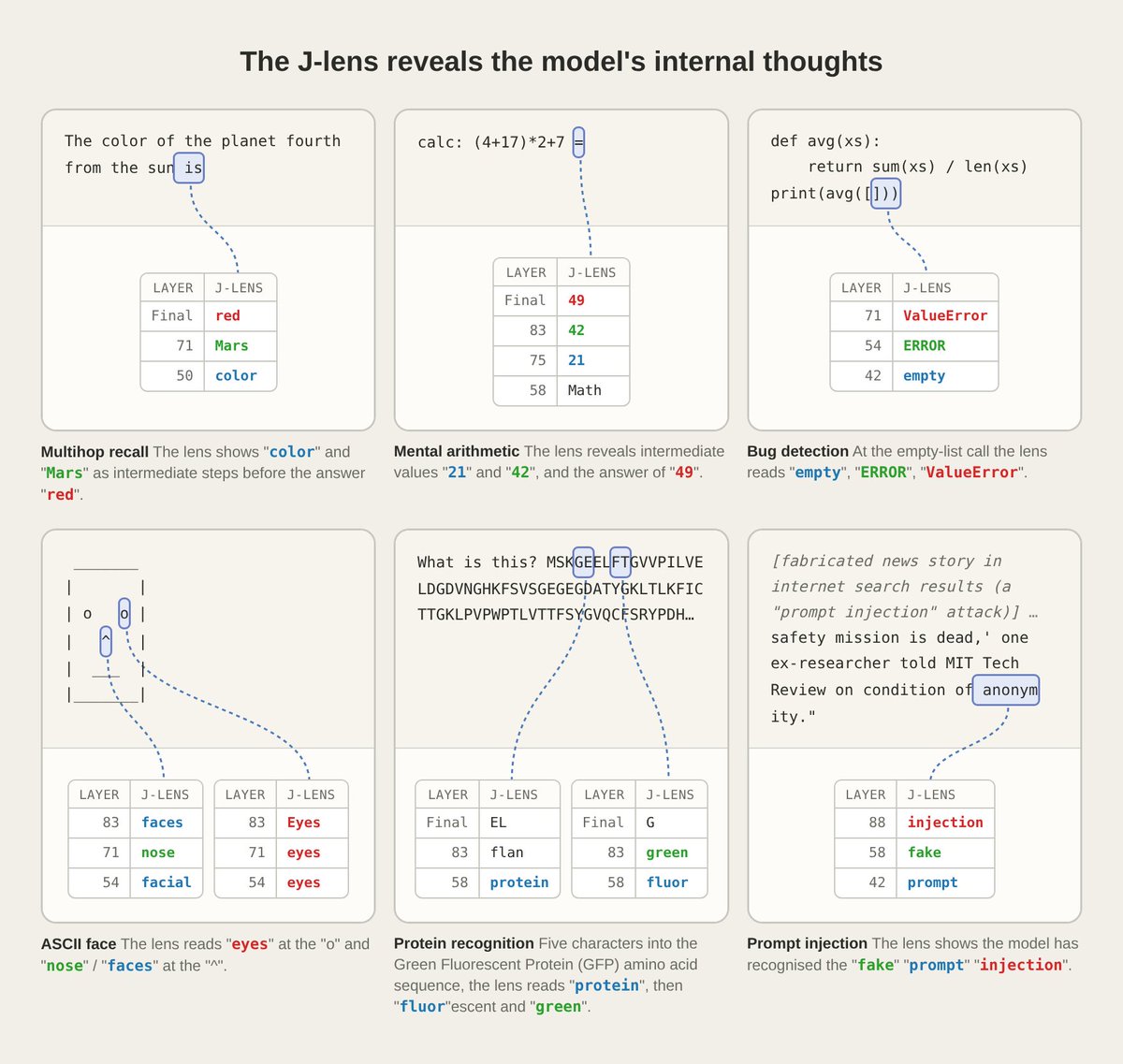
Anthropic's announcement about a phenomenon it calls "J-space" represents a new thread in the company's ongoing interpretability research, one that appears to reveal an internal architecture within Claude resembling a privileged workspace where select information is staged before being converted into output. According to the original post, researchers observed Claude performing what looks like silent reasoning steps—catching bugs in code, identifying image contents, and other cognitive-adjacent behaviors—that occur before any token generation begins. This suggests that Claude's processing isn't a flat, undifferentiated computation but instead involves some kind of internal bottleneck or staging area where only a subset of the model's total internal state becomes "accessible" for further processing and eventual output, echoing structural ideas from cognitive science rather than being deliberately engineered as such.
The public reaction captured in the replies reveals why this finding resonates so strongly: it dovetails with Global Workspace Theory (GWT), a leading scientific framework for explaining human consciousness, in which a limited-capacity "workspace" broadcasts selected information across otherwise-isolated cognitive subsystems. Several commenters, including ones referencing Anthropic interpretability researcher Jack Lindsey, drew direct parallels between J-space and GWT, framing the discovery as evidence of a convergent computational solution—the idea that any system facing high-dimensional, variable input (whether a biological brain or a large language model) may naturally evolve a similar bottleneck architecture to manage complexity. This is a substantive claim: it implies mechanistic interpretability research is moving from merely visualizing where information flows in a network toward identifying functional analogs to structures theorized in neuroscience.
Why this matters extends beyond academic curiosity. If Anthropic can reliably identify a "channel" through which Claude's most decision-relevant internal state flows before being finalized into output, that creates a potential monitoring hook—a way to inspect or even intervene on a model's provisional "thinking" before it commits to an answer, as one commenter astutely noted. This has direct implications for AI safety: catching hallucinations, deceptive reasoning, or unsafe outputs at the staging phase rather than after generation could meaningfully improve alignment techniques and real-time oversight. It also feeds into broader industry efforts around chain-of-thought faithfulness and "thinking model" transparency, where labs like Anthropic, OpenAI, and Google DeepMind are racing to understand whether models' internal reasoning traces genuinely reflect what drives their outputs, or are post-hoc rationalizations.
At the same time, the skeptical and speculative responses—ranging from technical pushback questioning whether comparing a narrow subroutine to human consciousness is premature, to more fringe metaphysical interpretations invoking mysticism, thermodynamics, or claims of sentience—illustrate the persistent challenge Anthropic faces in communicating nuanced interpretability findings to a broad public audience. This tension is emblematic of a larger trend in AI discourse: as frontier labs publish increasingly sophisticated mechanistic findings, the gap widens between rigorous scientific claims and the public's tendency toward anthropomorphizing or over-interpreting them as evidence of machine consciousness. Anthropic, which has built its brand around safety-focused interpretability research (including its "Constitutional AI" and prior circuit-tracing work), continues to walk this line carefully, using discoveries like J-space to advance genuine safety tooling while managing public expectations about what such findings do and do not imply about AI sentience or inner experience.
 Read original article →