Detailed Analysis
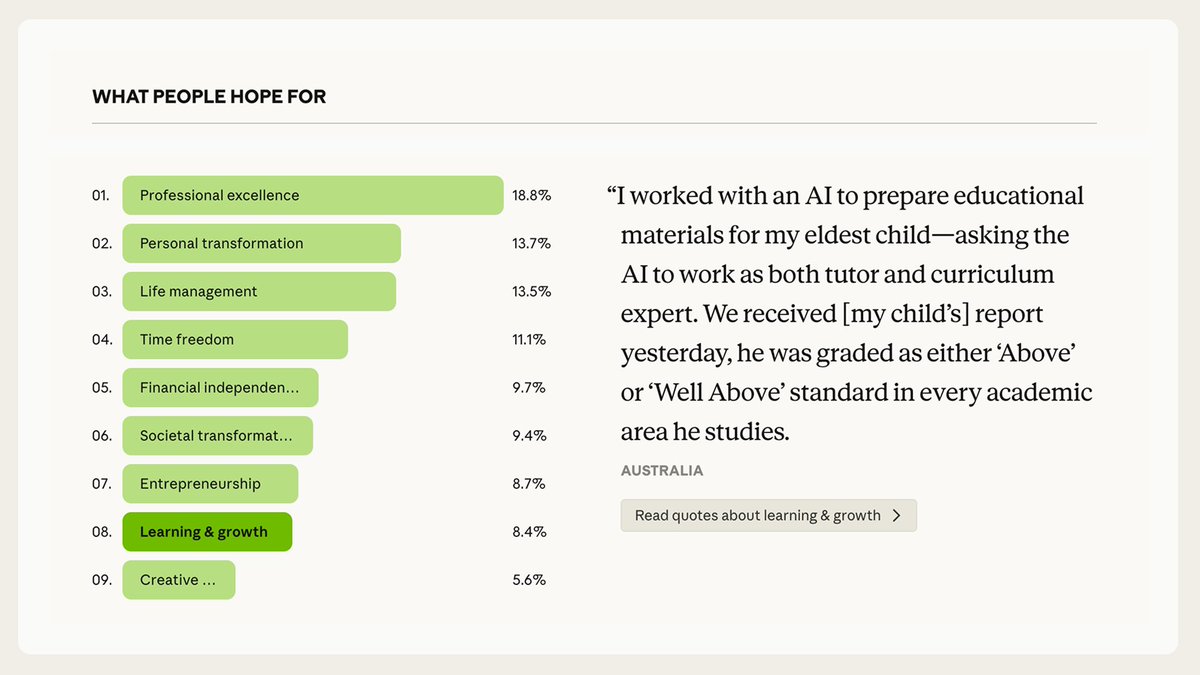
Anthropic conducted what appears to be one of the largest qualitative studies of AI user sentiment ever undertaken, gathering responses from approximately 81,000 Claude users in a single week. The core findings reveal a population of users with pragmatic, life-improvement priorities: roughly one-third want AI to improve their quality of life — specifically citing more time, financial security, and reduced cognitive burden — while approximately one quarter want AI to help them perform better and more fulfilling work. These findings suggest that the dominant public narrative around AI, which tends to emphasize existential risk and job displacement, may underweight the degree to which existing users are already thinking of AI as a personal productivity and wellbeing tool.
The social media response to the study announcement reveals a significant and ironic tension: many of the very users Anthropic surveyed about their AI aspirations were simultaneously voicing frustration with recent changes to Claude's pricing tiers, usage limits, and subscription structure. Multiple users complained about hitting hard usage caps within one to two days on paid plans, about unauthorized billing charges, and about the exclusion of third-party applications from discounted plans beginning in April 2026. This friction points to a structural gap between Anthropic's articulated mission — understanding and serving user needs at scale — and the operational experience many paying customers are currently having. The study's framing of broad user hopes stands in contrast to a replies section dense with billing disputes and service complaints.
The scale and methodology of the study itself carries significance beyond its findings. Anthropic framed the 81,000-response effort as a qualitative study — not merely a survey — which implies depth of interview and analysis beyond simple polling. If accurate, this would represent an unusually rigorous attempt by an AI company to ground product development in documented human aspiration rather than engineering possibility. One engaged commenter noted that 81% of respondents reported already feeling positive impact from Claude, suggesting that satisfaction and frustration can coexist among the same user base, with power users hitting limits precisely because their reliance on the tool has deepened.
The broader context is one of intensifying competition and commoditization in the large language model space. Users in the thread referenced OpenAI's GPT models, made comparisons around AGI benchmarks, and debated whether Claude's distinguishing features — particularly its 200,000-token context window — constitute durable advantages. Anthropic's decision to invest in large-scale user research at this moment reflects a calculated bet that differentiation will ultimately come not from raw capability benchmarks but from alignment with actual human needs and use cases. The study can be read as both a genuine research initiative and a strategic signal to the market that Anthropic intends to compete on user understanding as much as on model performance.
The findings also connect to a wider industry reckoning about what AI development is actually for. The gap between what AI companies build and what users meaningfully want has become a central debate in 2025 and 2026, as models have grown increasingly capable while user trust and satisfaction remain uneven. Anthropic's study, by surfacing the mundane but profound desires for time, financial stability, and meaningful work, implicitly challenges a technology sector that often defaults to capability maximalism as its north star. Whether the company translates these insights into product decisions — particularly around pricing accessibility and usage limits — will determine whether the research serves as a genuine compass or a well-publicized gesture.
 Read original article →