Detailed Analysis
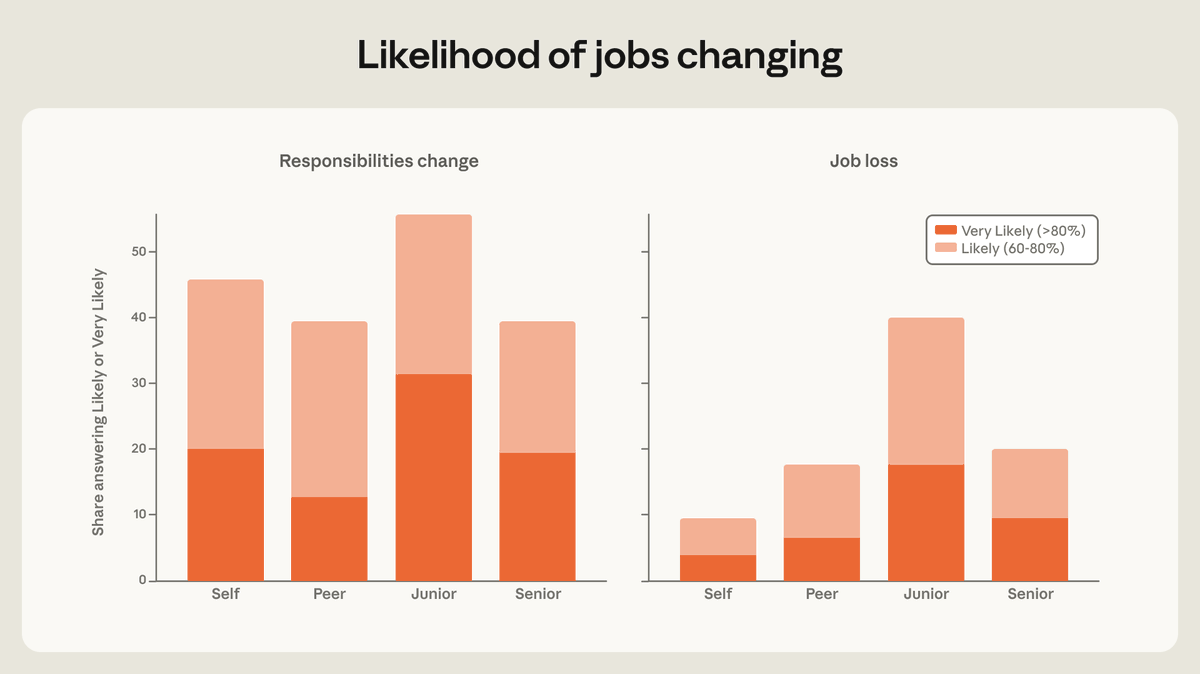
Anthropic's latest survey data reveals a striking disconnect in how workers perceive AI's threat to employment: nearly half of respondents anticipate their job responsibilities will change significantly within the next 12 months, yet fewer than 10% believe they personally face job loss in that timeframe. The more telling number lies in how respondents assess risk for others—over a third put the probability of a junior colleague losing their job above 60%. This gap between self-assessment and assessment of peers, particularly early-career workers, suggests a widespread belief that AI's disruptive effects will be real and severe, just not for oneself. It's a pattern familiar from other waves of technological disruption, where individuals tend to overestimate their own adaptability while recognizing structural risk more clearly when applied to others.
The specific concern about junior employees is significant and consistent with broader anxieties circulating in AI and labor economics discourse throughout 2025 and into 2026. Entry-level and junior roles have historically served as the training ground where new workers build expertise through repetitive, lower-stakes tasks—exactly the kind of work that generative AI tools like Claude are increasingly capable of automating. If organizations lean on AI to handle tasks traditionally assigned to junior staff, the entire pipeline for developing mid-career and senior talent could be disrupted, not just individual jobs. This survey data adds empirical weight to a concern that technologists, economists, and educators have been voicing anecdotally: that AI adoption may hollow out the bottom rungs of career ladders before its effects become visible further up the chain.
Anthropic's own commentary on the data emphasizes a shift in measurement philosophy—that understanding *how* people use AI, and how their workflows evolve over time, is becoming as important as simply tracking usage volume. This reflects the company's broader positioning as not just an AI lab building frontier models, but as a source of empirical research into AI's societal and economic effects, likely tied to its Economic Index initiative and related labor-market studies. By publishing granular data on worker sentiment rather than only usage statistics, Anthropic is attempting to shape the public conversation around AI's labor impact with data-driven nuance rather than speculation, positioning itself as a thoughtful steward of the technology it's deploying at scale.
The thread also surfaces a tangential but noteworthy geopolitical wrinkle: a reply referencing reports that Alibaba banned internal use of Claude Code, followed by public debate over the value of Chinese open-source AI models. This detail, though less substantiated in the original thread, hints at the competitive and political tensions surrounding AI tool adoption across the US-China divide, where Chinese firms face pressure to favor domestic AI infrastructure over foreign tools like Claude, even as debates continue about whether Chinese open-source models can match proprietary Western systems in capability. Taken together, the thread captures two intertwined threads of the current AI moment: growing empirical awareness of AI's uneven impact on different tiers of the workforce, and the increasingly geopolitical dimension of which AI tools get adopted, banned, or championed across major economies.
 Read original article →