Detailed Analysis
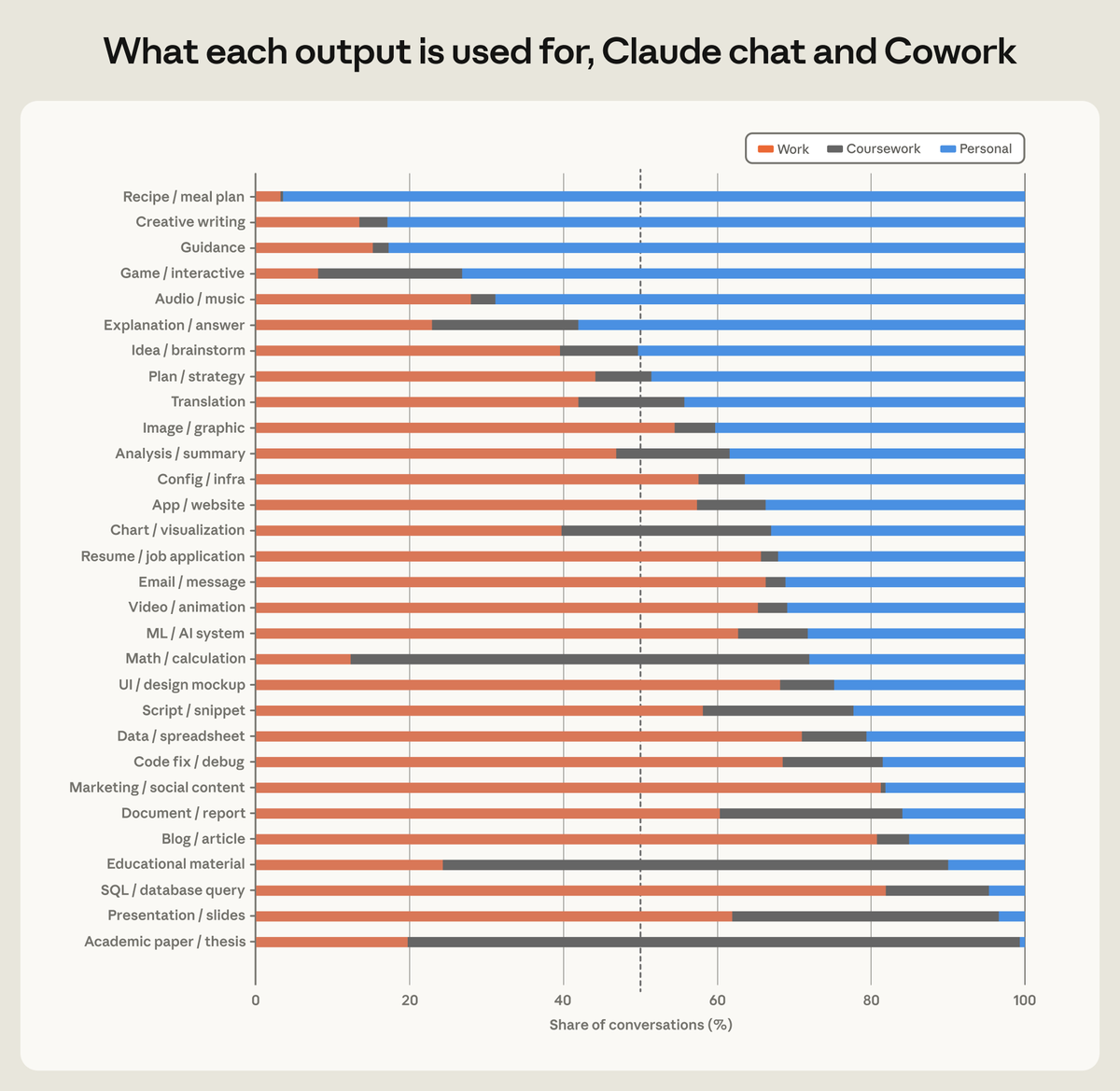
Anthropic's Economic Index has expanded its analytical scope to track "artifacts"—the discrete outputs Claude generates during a session, such as documents, code snippets, translations, or blog posts. This represents a methodological shift from earlier iterations of the Index, which primarily measured usage volume and task categories. By examining artifacts specifically, Anthropic is now able to classify not just what people ask Claude to do, but what tangible output results, and crucially, in what context that output is being used—professional work, academic coursework, or personal life. The example cited, comparing blogging (predominantly a workplace activity) against translation (which straddles professional and personal use), illustrates the kind of granular behavioral insight this new tracking enables.
This shift matters because it addresses a persistent gap in AI adoption research: usage frequency alone says little about how AI is actually reshaping labor and workflows. A model could be queried thousands of times for trivial tasks or a handful of times for high-value, workflow-altering outputs—raw interaction counts obscure this distinction. By anchoring analysis to artifacts, Anthropic can start to map economic activity more precisely, distinguishing between casual assistance and substantive work product generation. This aligns with a broader industry and academic push to move past crude "usage minutes" or "query volume" metrics toward measures that approximate actual economic substitution or augmentation—questions central to debates about AI's impact on employment, productivity, and the future of knowledge work.
The reply thread accompanying the announcement reveals two other narrative threads worth noting. One commenter emphasizes that understanding *how* AI changes workflows over time is becoming as important as measuring adoption levels, reflecting a maturing conversation in the AI policy and research community that has moved beyond simple growth metrics toward longitudinal behavioral change. The other, more provocative thread references reports that Alibaba internally banned use of Claude Code, allegedly followed by social media controversy over the value of Chinese open-source AI models. While unverified in this context, this claim taps into the intensifying geopolitical and competitive dynamics between US and Chinese AI labs, where restrictions on using rival companies' tools (especially coding assistants) have become a proxy battleground for broader questions about model quality, national AI sovereignty, and the credibility of open-source alternatives like Qwen or DeepSeek.
Taken together, these threads point to a broader trend: as foundation model usage becomes normalized across enterprises and geographies, the conversation is bifurcating into two tracks—rigorous, data-driven measurement of economic impact (exemplified by Anthropic's Economic Index refinements) and geopolitically charged narratives about which nations' AI ecosystems are gaining ground. Anthropic's artifact-tracking approach represents an attempt to ground the former in empirical rigor, offering policymakers, economists, and labor researchers a more nuanced lens on AI's diffusion into real work. Meanwhile, the swirling claims about corporate bans and open-source rivalry underscore how AI tool adoption itself has become entangled with national competitiveness narratives, a dynamic likely to intensify as companies like Anthropic, OpenAI, and Chinese labs continue to vie for enterprise and developer mindshare globally.
 Read original article →