Detailed Analysis
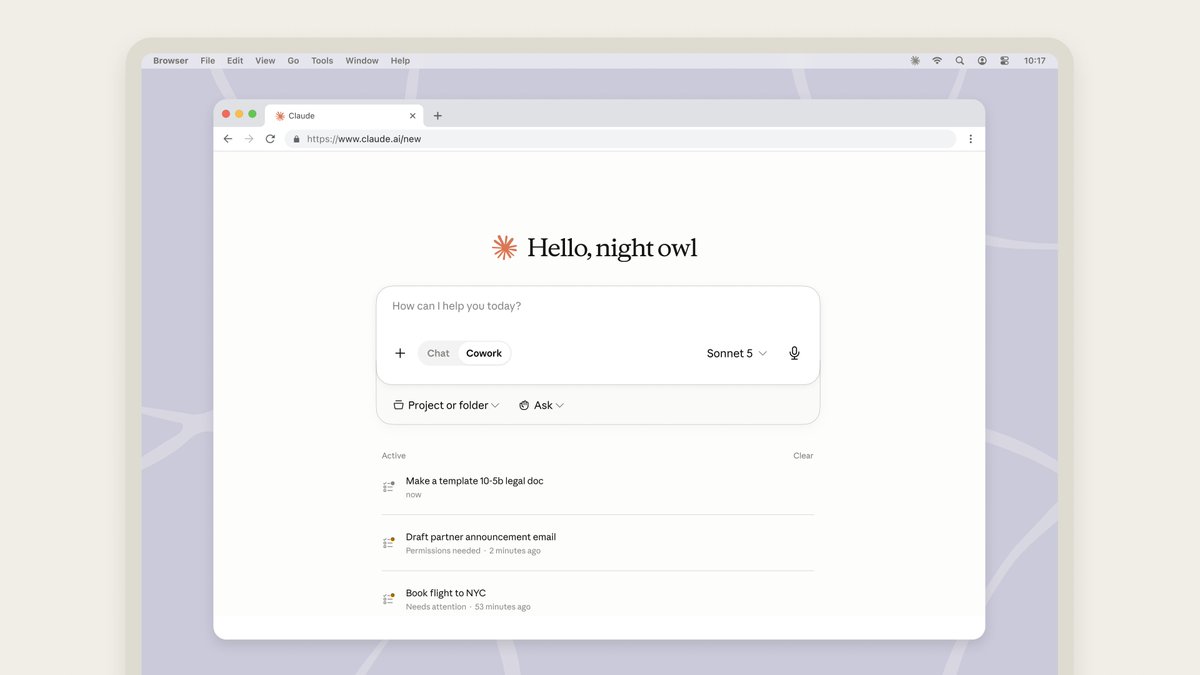
Anthropic's announcement that Chat and Cowork are merging into a unified home on web and desktop marks a notable consolidation in Claude's product architecture. Rather than maintaining separate interfaces for conversational interaction and autonomous task execution, Anthropic is collapsing these into a single environment where projects and artifacts persist across both modes. The framing—"handing Claude a task starts the same way a conversation does"—suggests a deliberate design philosophy: task delegation shouldn't require users to context-switch into a fundamentally different tool, but should feel like a natural extension of dialogue. This continues Anthropic's pattern of gradually blurring the line between chatbot and agent, following Cowork's earlier introduction as a more autonomous, folder-based work mode distinct from standard chat.
The public response captured in the replies reveals a user base sharply divided on execution, even if the underlying goal is understood. Some users welcome the integration as a genuine workflow improvement—one reply describes using the merged system for desktop-to-mobile handoffs, where Claude leaves a "where we left off" note so a session can resume with full context on another device. This kind of continuity is precisely what unified project/artifact storage across surfaces is meant to enable, and it points to real demand for Claude to function less like a single-session tool and more like a persistent collaborator across a user's devices and workflows. Other users, however, argue the merger is a UX regression, preferring the previous separation: Chat for exploratory research, Cowork for delegated tasks, and Claude Code for programming, each with dedicated project spaces. This tension reflects a common friction point in product design—simplifying the backend or mental model for new users can feel like a loss of precision and control for power users who had adapted to the more segmented structure.
Beyond the interface debate, the replies surface deeper anxieties about Anthropic's business model and technical execution. Complaints about refused prompts at the $200 Max tier, confusion over what "doubling Cowork usage limits" actually means when no Cowork-specific limits previously existed, and requests to extend features to Pro-tier users all point to persistent friction between Anthropic's safety-conscious product design and paying customers' expectations of capability and value. The comparison to GLM (a reference to competing open or lower-cost models) reflects an increasingly common complaint from Claude's user base: that safety refusals and usage caps make premium subscriptions feel like poor value relative to more permissive alternatives. One reply's confrontational rhetoric about lying to a board and investors—while inflammatory—captures a broader undercurrent of skepticism about whether frontier AI labs are transparent about model capabilities, limitations, and the sustainability of their pricing and safety tradeoffs.
Taken together, this episode illustrates the broader trend of AI companies racing to unify chat, agentic task execution, and coding assistance into single, seamless products, mirroring similar consolidation moves across the industry as vendors compete to become users' default "AI operating layer." Anthropic's move toward persistent, cross-surface continuity—projects and artifacts following users from desktop to mobile—signals where the competitive frontier is shifting: not just raw model capability, but the surrounding infrastructure of memory, handoff, and workflow integration. At the same time, the vocal frustration in the replies underscores that product unification carries real costs in user trust and usability, and that Anthropic faces mounting pressure to justify premium pricing amid a market where users are acutely aware of cheaper, less restricted alternatives.
 Read original article →