Detailed Analysis
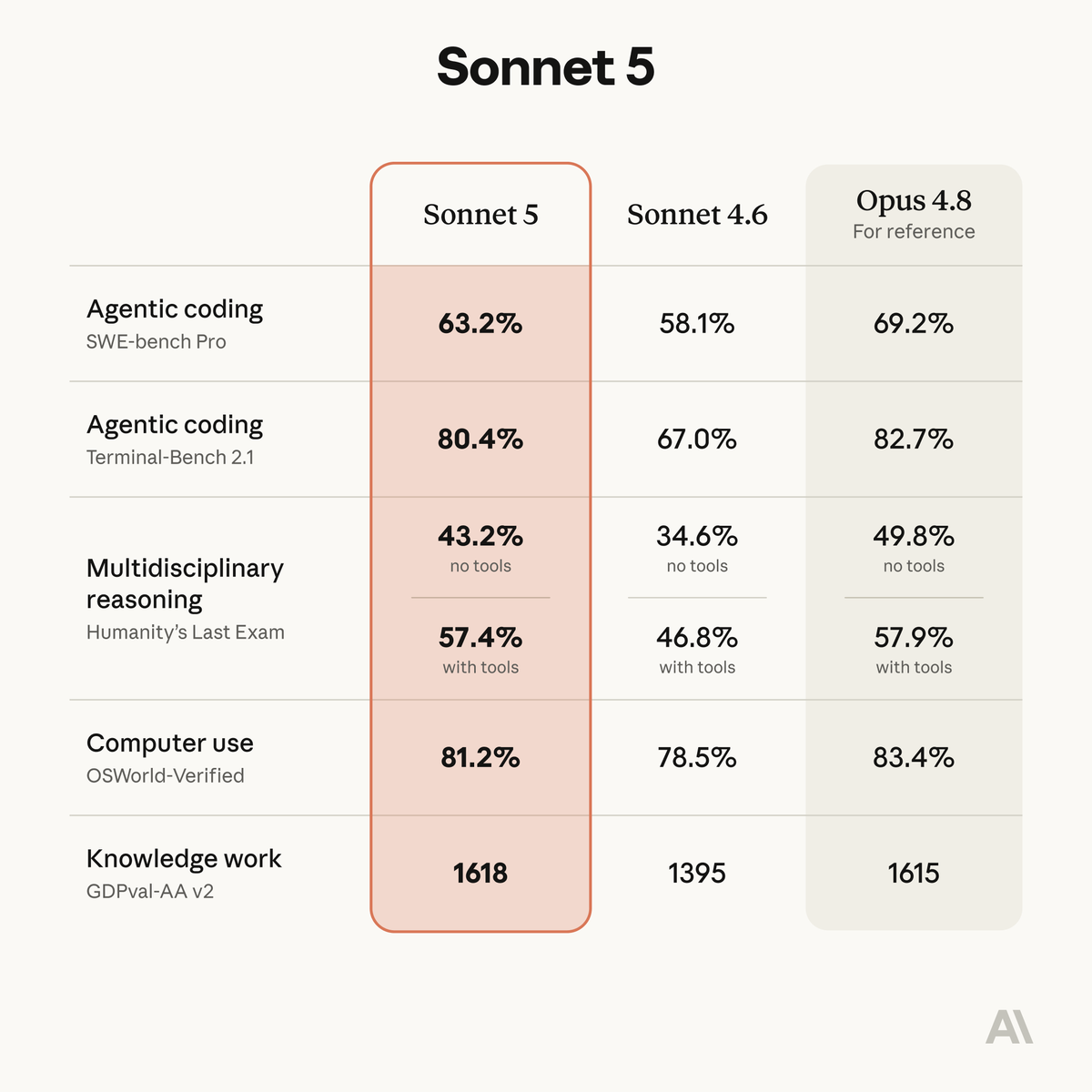
Anthropic's announcement of Claude Sonnet 5 signals another iteration in the company's rapid model-release cadence, positioning the new model as a substantial upgrade over its predecessor, Sonnet 4.6, across four key capability areas: reasoning, tool use, coding, and knowledge work. Notably, the announcement frames Sonnet 5's performance as approaching that of Opus 4.8—Anthropic's higher-tier, more expensive flagship model—while being offered at a lower price point. This positioning is a familiar pattern in Anthropic's product strategy, wherein the "Sonnet" tier serves as the workhorse model that captures most of the flagship's capability at a fraction of the cost, making advanced AI more accessible to a broader base of developers and enterprises.
The specific emphasis on reasoning and tool use is significant given the trajectory of the AI industry in 2025 and into 2026, which has shifted decisively toward agentic AI systems—models that don't just generate text but actively plan, execute multi-step tasks, and interact with external tools, APIs, and environments. Improvements in tool use directly translate to better performance in autonomous coding agents, research assistants, and enterprise workflow automation, all areas where Anthropic has aggressively positioned Claude against competitors like OpenAI's GPT series and Google's Gemini models. Coding capability improvements are particularly consequential, as coding has become the primary battleground for frontier model differentiation, with Claude models historically earning strong reputations among developers for code quality and instruction-following in tools like Claude Code, Cursor, and other AI-assisted development environments.
The pricing angle—delivering near-Opus performance at Sonnet-level cost—reflects broader economic pressures across the AI industry to reduce inference costs while maintaining or improving capability. As foundation model companies compete for enterprise contracts and developer mindshare, the ability to offer "good enough" performance at dramatically lower prices has become as important a competitive lever as raw benchmark superiority. This mirrors trends seen across the industry where mid-tier models increasingly close the gap with top-tier offerings from just months prior, effectively commoditizing capability levels that were previously exclusive to the most expensive tiers.
More broadly, this release fits into the pattern of near-continuous model iteration that has come to define the frontier AI landscape, where version numbers climb steadily (Sonnet 4.6 to Sonnet 5, alongside Opus 4.8) as labs race to maintain competitive positioning. The brevity and informality of the announcement—posted as a social media update rather than a detailed technical report—suggests this is one of many incremental releases in an ongoing cycle, part of the "ship fast, iterate often" ethos that has increasingly characterized AI lab communications, prioritizing rapid deployment and real-world feedback over lengthy pre-release validation cycles. This pattern reflects the competitive intensity of the current AI market, where staying ahead requires constant refinement rather than infrequent, monumental releases.
 Read original article →