Detailed Analysis
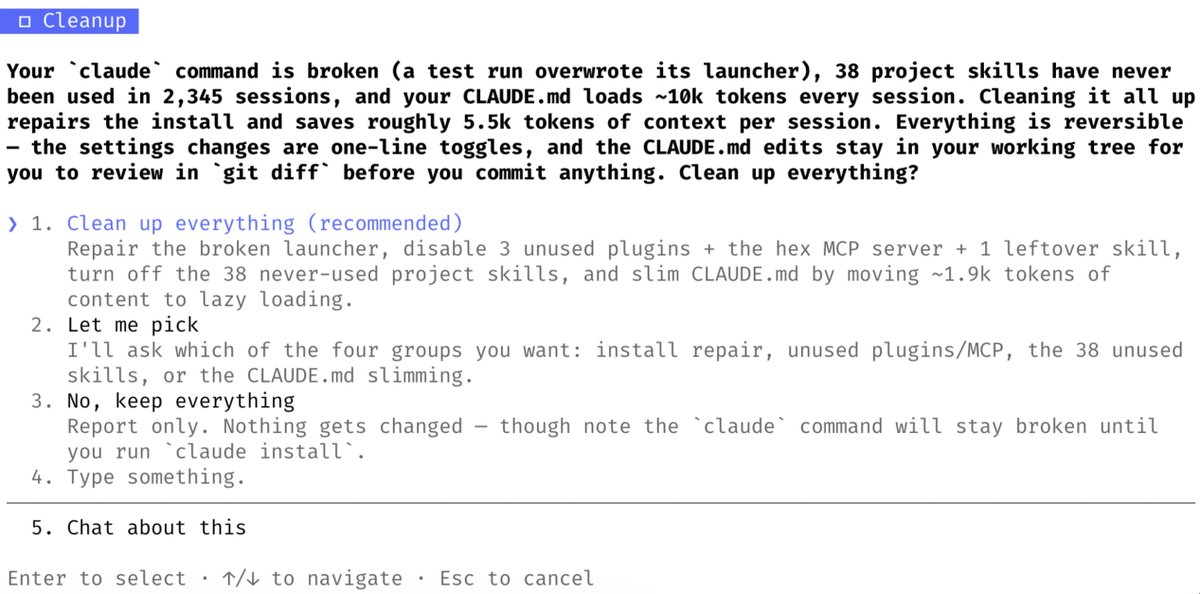
A tweet thread centered on Boris Cherny, a prominent figure on the Claude Code engineering team at Anthropic, surfaced a wave of community reactions to the `/checkup` command—a diagnostic or hygiene feature within Claude Code designed to help users audit and clean up their accumulated Skills and Plugins. The original poster's framing of `/checkup` as "the hygiene pass most people skip" resonated with a common pain point among power users: as Claude Code environments grow more sophisticated, users accumulate custom Skills, Plugins, and configurations that, like files in an unmanaged desk drawer, become cluttered and inefficient over time. The suggestion to "chain the ones that run the real job" rather than simply adding more agents reflects a maturing philosophy in agentic AI tooling—one that favors curation and composability over unchecked proliferation of capabilities.
The replies reveal a cross-section of issues and requests that illustrate both the enthusiasm and friction points within Claude Code's user base. One user flagged a specific bug where the "Fable" advisor—apparently a model or persona option within the Claude Code ecosystem—becomes unavailable unless users manually switch models, suggesting a state-management or session-handling issue that Anthropic's team would need to address. Another exchange touched on a more conceptual challenge: the limitations of CLAUDE.md, the convention Anthropic uses for persistent, team-shared context files that travel with a codebase across sessions. The commenter noted that while CLAUDE.md provides valuable portability, it lacks a "compiled summary" host layer that would enable true cross-project memory, pointing to an unresolved architectural gap between session-level context and longer-term, project-spanning knowledge retention.
Other requests hint at the practical, sometimes mundane needs of developers using Claude Code across different environments and platforms. Users asked for `/compact` command support via mobile remote control, for the Claude desktop app to support Fedora Linux (beyond the officially supported distributions), and inquired in Chinese about which CLI tool Cherny was using—underscoring Claude Code's growing international developer base. These scattered but specific asks are typical of an actively developed CLI/agentic coding tool still expanding platform support and refining its command surface area.
Collectively, this thread captures a snapshot of the organic, community-driven feedback loop that characterizes Claude Code's development cycle. Rather than formal feature announcements, much of the product's evolution appears to be shaped through direct engagement between Anthropic engineers like Cherny and the developer community on social media, where bug reports, feature requests, and philosophical discussions about context management coexist in real time. This pattern reflects a broader trend in the agentic coding tool space—exemplified also by GitHub Copilot Workspace, Cursor, and similar products—where the rapid iteration cycle depends heavily on power users stress-testing features like Skills, Plugins, and persistent memory systems, then surfacing friction points directly to the builders. The emphasis on "hygiene" commands like `/checkup` also signals an industry-wide recognition that as AI coding agents become more capable and configurable, tooling for managing complexity itself becomes as important as the raw capabilities being added.
 Read original article →