Detailed Analysis
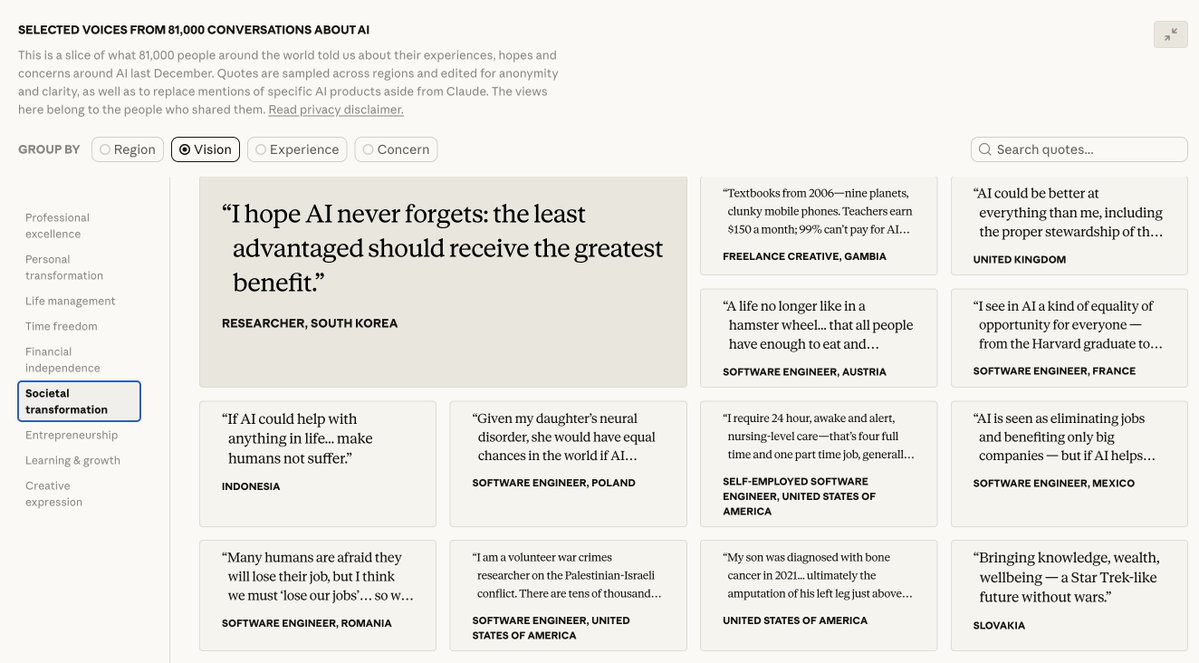
Anthropic deployed a specialized version of its Claude AI model — dubbed "Anthropic Interviewer" — to conduct a large-scale qualitative research initiative, gathering responses from over 81,000 Claude users across 159 countries and in 70 different languages within a single week. The tool was prompted to carry out conversational interviews, allowing Anthropic to gather nuanced, open-ended input at a scale that traditional survey methodologies could not easily replicate. The company published a selection of participant quotes, offering a window into the breadth of global perspectives on AI use, hopes, and anxieties. The scope of the effort — described by some observers as the largest qualitative study of its kind — reflects Anthropic's stated interest in grounding its AI development in real-world human sentiment rather than exclusively in internally generated benchmarks or narrow user feedback loops.
The public reaction to the announcement reveals a significant tension between Anthropic's aspirational research framing and the lived frustrations of its paying user base. A substantial portion of the social media responses quoted in the article are not about the research at all, but rather expressions of dissatisfaction with usage limits, billing disputes, unresponsive customer support, and recent pricing changes. Multiple users report hitting Claude Pro and Max plan caps within one to two days, encountering hard stops with no fallback access, and receiving no human support responses for unauthorized charges or technical failures. This disconnect — between a company conducting a sweeping global study on what people hope for from AI and users unable to get basic account support — underscores a recurring challenge for rapidly scaling AI companies: the gap between product vision and operational execution.
The research itself carries meaningful strategic implications. By using Claude as the interviewer in a study about Claude users, Anthropic is demonstrating a concept of AI-mediated qualitative research at scale — a methodology that, if reliable, could fundamentally change how technology companies gather human insight. Conducting 81,000 conversational interviews through human researchers would be logistically and financially prohibitive; routing the process through a prompted AI model compresses timelines dramatically while enabling multilingual reach. Whether the resulting data captures authentic human sentiment with the same fidelity as skilled human interviewers remains an open methodological question, but the experiment itself represents a notable data point in the ongoing exploration of AI as a research instrument rather than merely a research subject.
The broader context situates this initiative within a recognizable trend among frontier AI labs to position themselves as responsible, human-centered developers. Gathering large-scale qualitative data on user hopes and fears — and publishing quotes from respondents in dozens of languages — signals a commitment to global inclusivity and value alignment that aligns with Anthropic's public safety mission. At the same time, the chorus of complaints in the social media thread about pricing changes, token limits, and billing errors points to the commercial pressures Anthropic faces as it attempts to monetize its models aggressively enough to fund continued research. The April 2026 decision to restrict third-party app usage from discounted plans, cited by one user, exemplifies how the company's pricing architecture is evolving in ways that create friction for developers and power users even as its research arm projects openness and curiosity about human needs.
Taken together, the Anthropic Interviewer project illustrates both the promise and the complexity of AI companies turning their own tools inward for institutional purposes. The methodological innovation of using a conversational AI to conduct research at global scale is genuinely significant, and the resulting dataset — if responsibly analyzed — could inform more human-aligned model development. Yet the simultaneous groundswell of user frustration visible in the article's comment thread serves as an unintentional counterpoint: the people Anthropic is studying are, in many cases, the same people struggling to use its products under tightening constraints. How Anthropic reconciles the insights from 81,000 interviews with the operational realities its users are experiencing will be a meaningful test of whether large-scale human feedback research translates into tangible product and policy improvements.
 Read original article →