Detailed Analysis
Anthropic has published a guidance article distinguishing two speech-based interaction modes within Claude: dictation and voice mode, framing them not as redundant features but as tools suited to fundamentally different cognitive tasks. Dictation functions as a straightforward speech-to-text replacement for typing—users speak, their words appear as editable text in the message box, and Claude responds in its standard text format. Voice mode, by contrast, is a live spoken conversation where Claude talks back audibly, allows interruptions, and is positioned as a thinking partner for working through ambiguous problems, rehearsing difficult conversations, or processing information out loud. The article's central thesis—"dictation gets your words down; voice mode helps you work out what you think"—reflects a broader design philosophy of treating voice not as a single input method but as two distinct interaction paradigms tied to user intent.
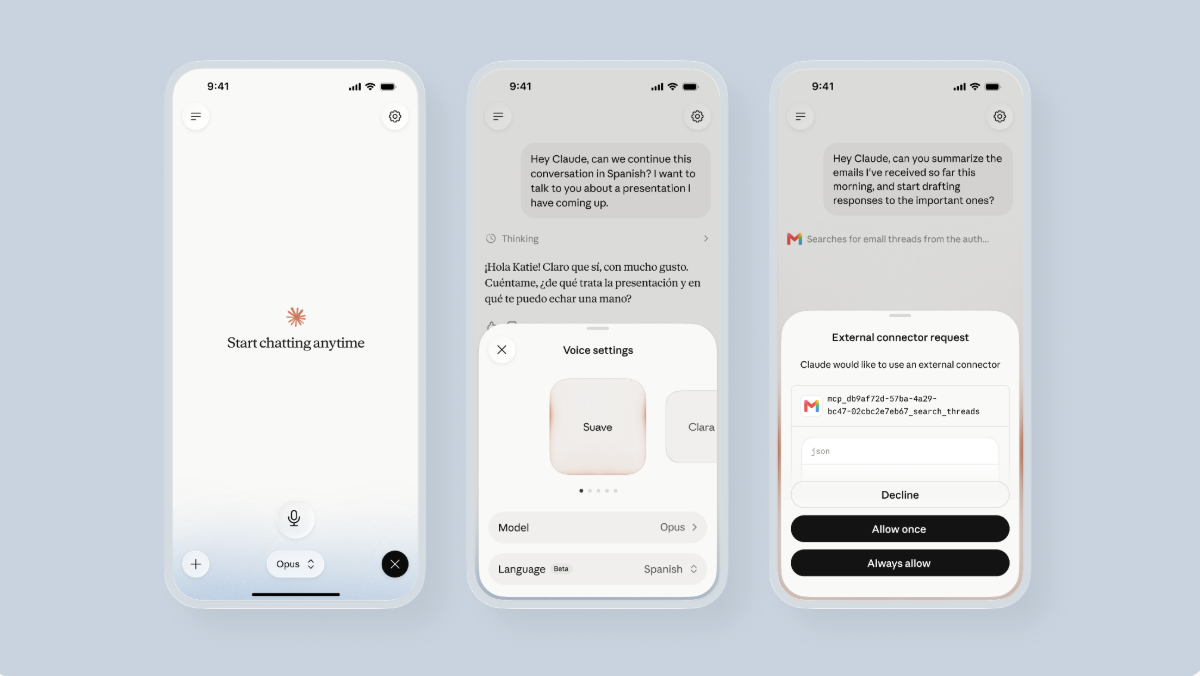
The more substantive news embedded in this guide is a significant upgrade to voice mode itself. Previously limited to a faster, lighter-weight model, voice conversations on paid plans can now run on Anthropic's more capable Opus and Sonnet models, with users able to switch models mid-conversation via a model picker as discussions grow more complex. Voice mode has also gained access to connected productivity tools—email, calendar, documents, and Slack—allowing users to ask Claude to summarize their inbox or prep for a meeting without leaving the spoken conversation. Additionally, voice conversations now persist in memory like text chats, meaning users can pick up prior spoken exchanges later, and the feature has expanded beta support for languages beyond English, addressing a notable gap for non-English speakers and language learners.
These upgrades matter because they signal Anthropic's intent to make voice a first-class, persistent modality rather than a novelty bolted onto the chat interface. By enabling tool access and model flexibility within voice conversations, Anthropic is positioning Claude as a viable hands-free assistant for real-world workflows—reviewing documents while commuting, prepping for sales calls, or debriefing after meetings—rather than a simple dictation gimmick. The emphasis on memory continuity and the ability to move fluidly between voice and text (starting a conversation on a walk, then switching to dictation at a desk to refine it) reflects a push toward treating the assistant as a continuous companion across contexts and devices, rather than siloed sessions per interface.
This development fits into a broader industry trend of AI assistants racing to own the voice interaction layer, as competitors like OpenAI's ChatGPT Advanced Voice Mode and Google's Gemini Live have already invested heavily in real-time, multimodal conversational AI. Anthropic's move to bring its flagship reasoning models (Opus, Sonnet) into voice—rather than relegating voice users to a stripped-down model—suggests a bet that voice interactions increasingly involve substantive reasoning tasks (negotiation prep, decision-making, document analysis) rather than simple commands. Coupled with tool integration into voice sessions, this positions Claude to compete not just as a chatbot but as an ambient, agentic assistant capable of acting on a user's behalf across email, calendars, and documents while maintaining natural spoken dialogue—a capability increasingly central to the "AI agent" narrative shaping the industry in 2025-2026.
 Read original article →