Detailed Analysis
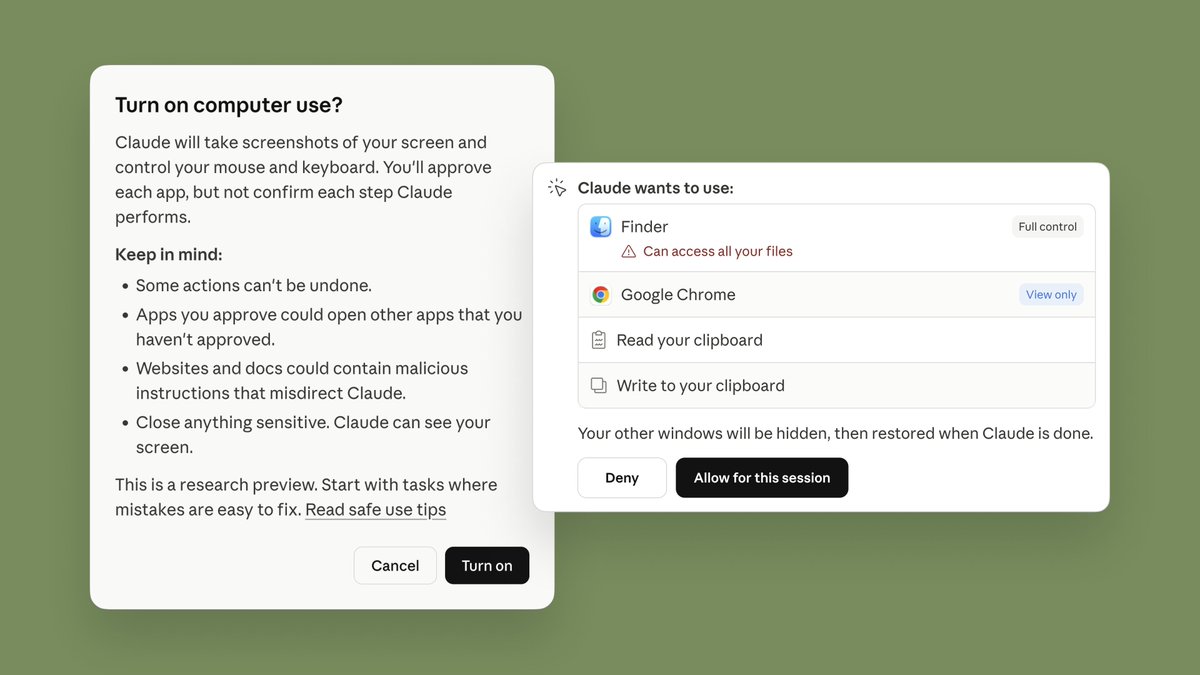
Anthropic's Claude has introduced a tiered app-interaction system that prioritizes structured connectors for tools like Slack and Google Calendar before escalating to direct computer use — a capability that allows Claude to take screenshots, move a mouse, and interact with on-screen elements when no native integration exists. The feature represents a significant architectural decision: rather than defaulting immediately to raw screen control, Claude attempts to use sanctioned API-level connectors first, only requesting permission to operate the user's interface directly when no such pathway is available. At the time of writing, the capability appears to be rolling out on macOS, with Windows and Linux availability still unconfirmed, a limitation that has generated substantial user frustration given the prevalence of those platforms in professional and enterprise environments.
The public reaction captured in the surrounding social media discourse reveals two sharply divergent responses. One segment of users expresses genuine awe at the velocity of AI capability expansion — noting, accurately, that the transition from Claude as a text-generation tool to Claude as a system-level operator capable of navigating arbitrary software has occurred within roughly two years. Several users are already deploying autonomous Claude instances in cloud environments, using them for overnight research, email drafting, and morning briefings delivered via messaging apps. This use pattern illustrates that early adopters are not simply testing computer use as a novelty but integrating it into persistent, semi-autonomous workflows that run without direct human supervision.
A parallel and equally prominent strand of the discourse centers on trust, accountability, and service reliability. Observers raise pointed questions about auditability — specifically, whether users can clearly trace what Claude touched, what it changed, and who bears responsibility when errors occur. These are not abstract concerns: the capacity to interact with production software, file systems, and communication tools at the UI level creates real exposure to irreversible actions. Compounding this, a notable volume of the surrounding posts document serious billing disputes, unauthorized charges, and unresponsive support channels, suggesting that Anthropic's operational infrastructure is under stress at precisely the moment it is expanding Claude's ambient presence in users' digital environments.
The development fits squarely within the broader industry trend toward agentic AI — systems designed not merely to respond to prompts but to execute multi-step tasks across heterogeneous software environments. Competitors including OpenAI and Google have pursued analogous computer-use and agent-orchestration capabilities, making this a competitive frontier rather than a differentiating outlier. The connector-first architecture Anthropic has chosen reflects a meaningful design philosophy: structured integrations are more predictable, auditable, and reversible than raw GUI automation, and defaulting to them when available reduces the surface area of unintended consequences. Whether that philosophy translates into the kind of legible, trustworthy behavior that drives mainstream adoption — particularly in enterprise contexts governed by compliance requirements — will depend heavily on how Anthropic develops the transparency and permission-management layers that users are already demanding.
 Read original article →