Detailed Analysis
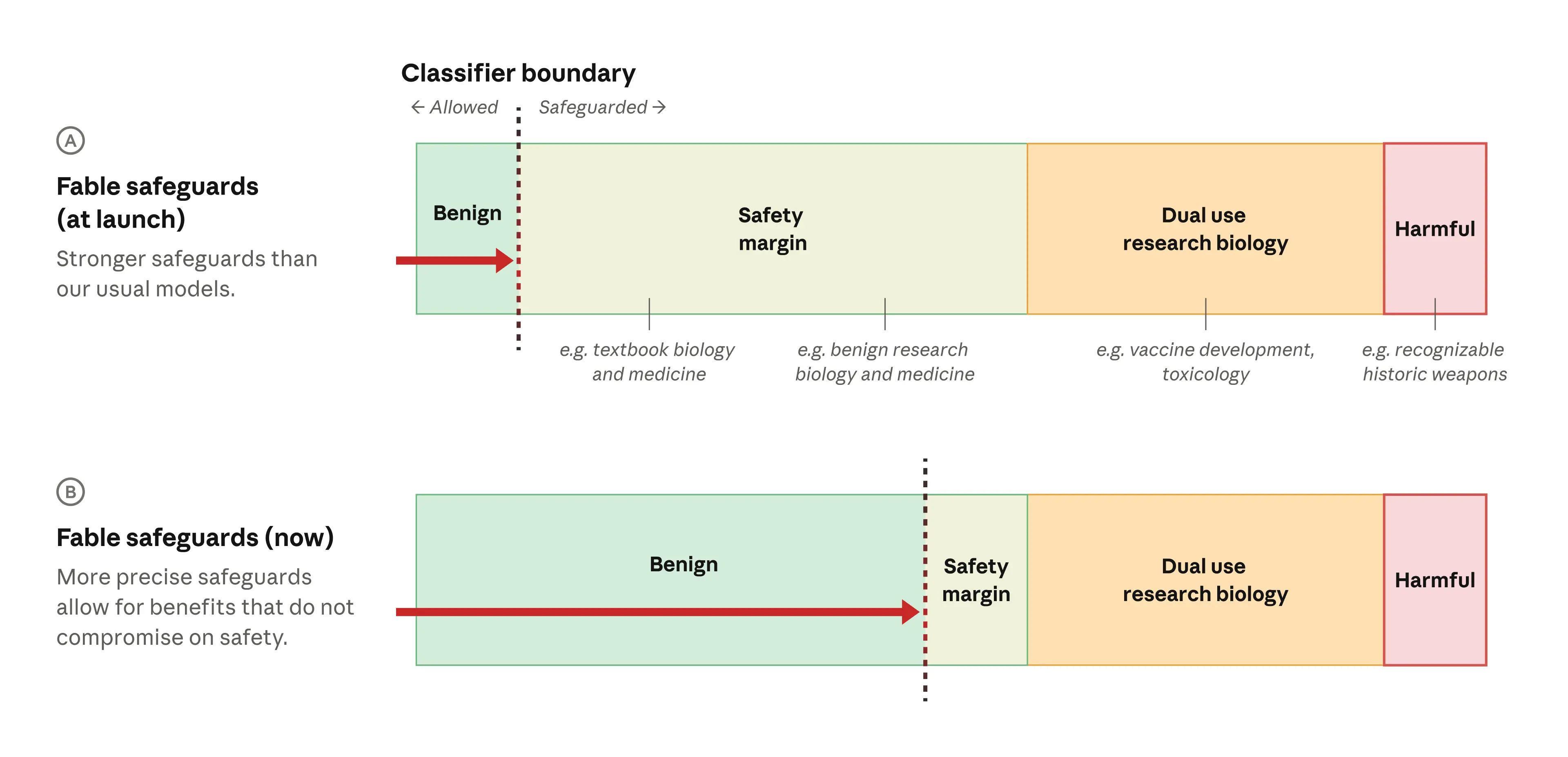
Anthropic's announcement regarding Claude Fable 5 details a significant recalibration of the biology-safety classifier system that governs how the model handles biology-related queries. The core update reduced false-positive "fallbacks"—instances where the system routes a user's biology question to the less-capable Opus 5 model—by approximately 85% across product surfaces. This is a substantial technical achievement, given that Fable 5 was originally launched with an intentionally broad and blunt biology classifier that erred heavily toward caution, blocking a wide swath of ordinary, benign requests such as lab-result interpretation, symptom research, and biology education. Rather than delaying the model's release by weeks or months to perfect the classifier, Anthropic chose to ship Fable 5 with overly conservative safeguards and iterate afterward—a decision the company frames as a deliberate tradeoff between speed of access and precision of restriction.
The underlying tension driving this story is the dual-use nature of advanced biological capability in frontier AI models. Anthropic states plainly that Fable 5 can now outperform human experts on some complex biological tasks and offer meaningful operational support on others, which makes it valuable to legitimate researchers developing treatments but also potentially dangerous in the hands of a malicious actor attempting to develop a biological weapon. The company's own capability assessments reportedly show the model could provide "significant uplift" to such actors—meaning it could supply expertise unavailable elsewhere. This mirrors a broader challenge across the AI safety field: as models cross capability thresholds in chemistry, biology, radiological, and nuclear (CBRN) domains, developers must build classifiers and access controls sophisticated enough to distinguish intent, not just topic, since the same underlying science (isolating snake venom toxins to create captopril, growing live pathogens for vaccines) can serve either beneficial or catastrophic purposes.
Notably, the article invokes external validation for this concern, citing the US Intelligence Community's 2026 Annual Threat Assessment, which warns that synthetic biology and genomic editing "could lead to novel biological threats" and that several state actors likely maintain active offensive biological and chemical weapons programs. This framing situates Anthropic's classifier work not as an abstract product-safety exercise but as a response to a documented geopolitical risk landscape, where frontier AI capabilities could plausibly accelerate state or non-state weapons development. It also underscores why the company distinguishes between "everyday" biology use cases now being unblocked and higher-risk categories—virology, toxicology, and molecular design—that remain routed to Opus 5 regardless of the classifier improvements, since these are the areas most directly relevant to weaponization pathways.
Beyond the immediate product update, the announcement signals Anthropic's broader strategic ambition to eventually offer "trusted access pathways" that would let vetted biology researchers and drug developers use Fable 5's full frontier capabilities—something the company frames as its highest-value application area for AI's positive impact on the world. This reflects an industry-wide pattern of building tiered-access infrastructure (verified researcher programs, institutional partnerships, KYC-style vetting) as a middle path between blanket restriction and unrestricted release, a model already emerging in nuclear and cybersecurity-adjacent AI applications. The piece also offers a rare degree of transparency into the mechanics of classifier development—the iterative tuning between false positives and false negatives, and the need for robustness against jailbreak attempts—which reflects a growing norm among frontier labs to publish safety methodology details, both for accountability and to establish industry practice around managing dual-use AI capabilities as models continue to approach or exceed expert-level performance in high-stakes scientific domains.

 Read original article →