Detailed Analysis
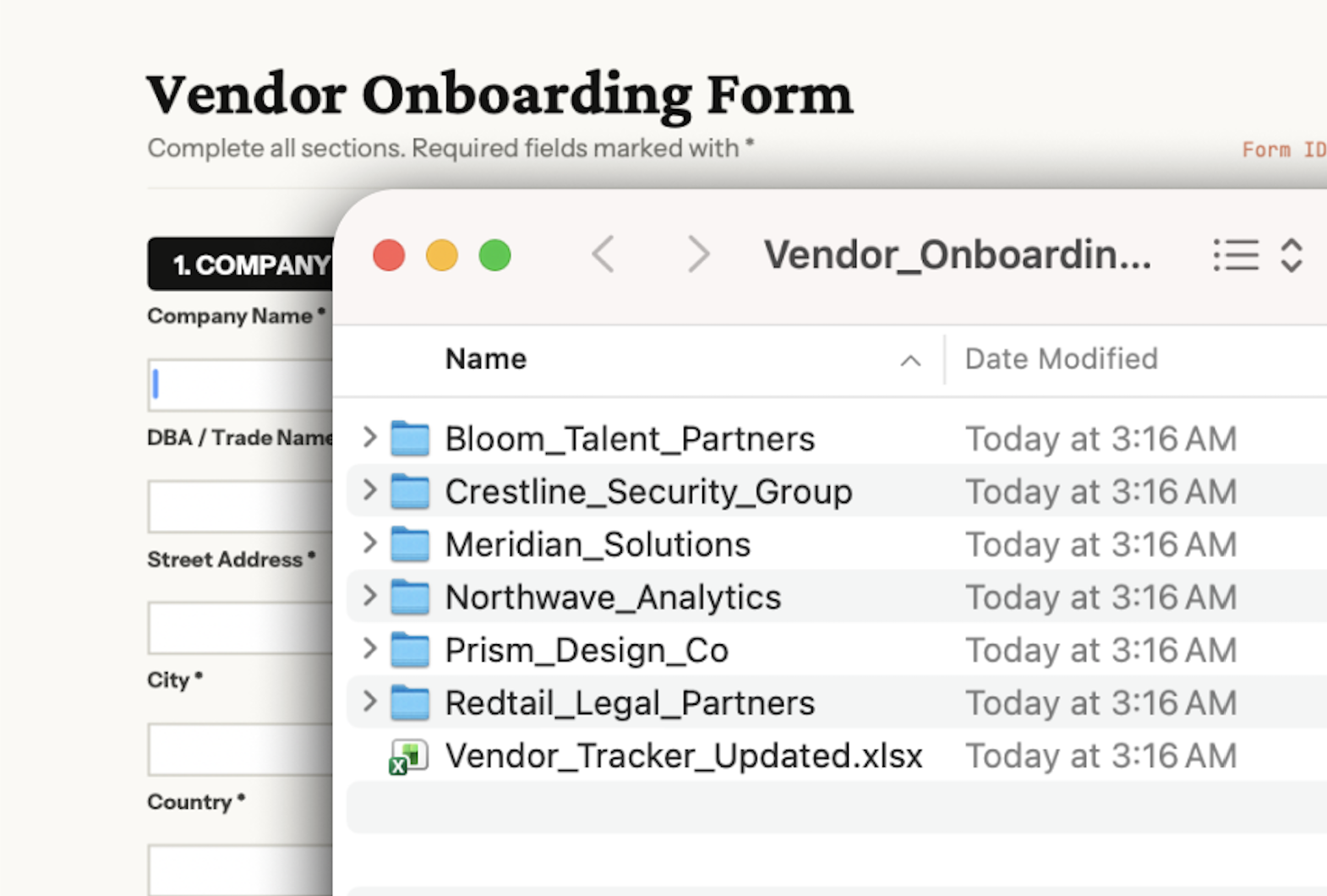
Anthropic's latest use-case showcase for Cowork demonstrates how Claude can function as an operational assistant for back-office procurement workflows, specifically vendor onboarding. The featured example shows Claude reading a folder of vendor documents, contract templates, and a tracking spreadsheet from a user's desktop, then autonomously generating NDAs and MSAs, filling out intake forms in a procurement portal via Claude in Chrome, updating a vendor tracker spreadsheet, and organizing files into structured folders—all within a single session spanning both local files and browser-based tools. This represents a notable expansion beyond conversational AI assistance into genuine task execution across multiple software environments without requiring the user to manually copy, paste, or switch between applications.
The significance of this release lies in its demonstration of agentic capabilities applied to a specific, high-friction business process. Vendor onboarding is a classic example of tedious, multi-step administrative work that involves cross-referencing information across documents, populating templates, and manually entering data into multiple systems—exactly the kind of repetitive, rules-based task that consumes disproportionate time in procurement, legal, and operations teams. By combining Cowork's local file access with the Claude in Chrome browser connector, Anthropic is positioning Claude not just as a document generator but as an orchestrator that can complete an entire workflow end-to-end, including logging into authenticated portal sessions and submitting forms. The emphasis on Claude building a visible plan before executing, and displaying its progress in a sidebar panel, reflects a broader design philosophy at Anthropic around transparency and steerability in agentic systems—important given the sensitivity of legal contracts and vendor data.
The technical architecture underlying this use case is also noteworthy: Claude's ability to spin up subagents to handle independent tasks in parallel (e.g., updating the tracker while simultaneously generating a contract) signals a shift toward more sophisticated task decomposition and parallelization within a single agent session. This mirrors trends across the AI industry toward multi-agent orchestration, where a primary agent coordinates specialized subagents to improve speed and reliability on complex workflows. It also reflects Anthropic's continued investment in tool use and computer control, building on the "computer use" capabilities it introduced with Claude 3.5 Sonnet in 2024, now packaged into more polished, business-ready products like Cowork and Claude in Chrome.
More broadly, this release fits into the industry-wide push to move AI assistants from chat-based Q&A tools toward autonomous "agentic" systems capable of completing real-world, multi-application tasks with minimal supervision. Competitors like OpenAI (with its Operator and agent tooling) and Google are pursuing similar visions of AI that can navigate browsers, manipulate files, and interact with enterprise software on a user's behalf. Anthropic's framing—emphasizing enterprise use cases like procurement, contract generation, and CRM-style data entry—suggests a deliberate strategy to capture business and knowledge-worker productivity markets, where the ROI of automating structured administrative workflows is easier to quantify than more open-ended creative or research tasks. As these agentic capabilities mature, they raise important questions about authentication security, error-checking in generated legal documents, and the appropriate level of human review before an AI-completed workflow is considered final—issues Anthropic partially addresses here by having Claude leave portal forms ready for human review rather than auto-submitting them.
 Read original article →