Detailed Analysis
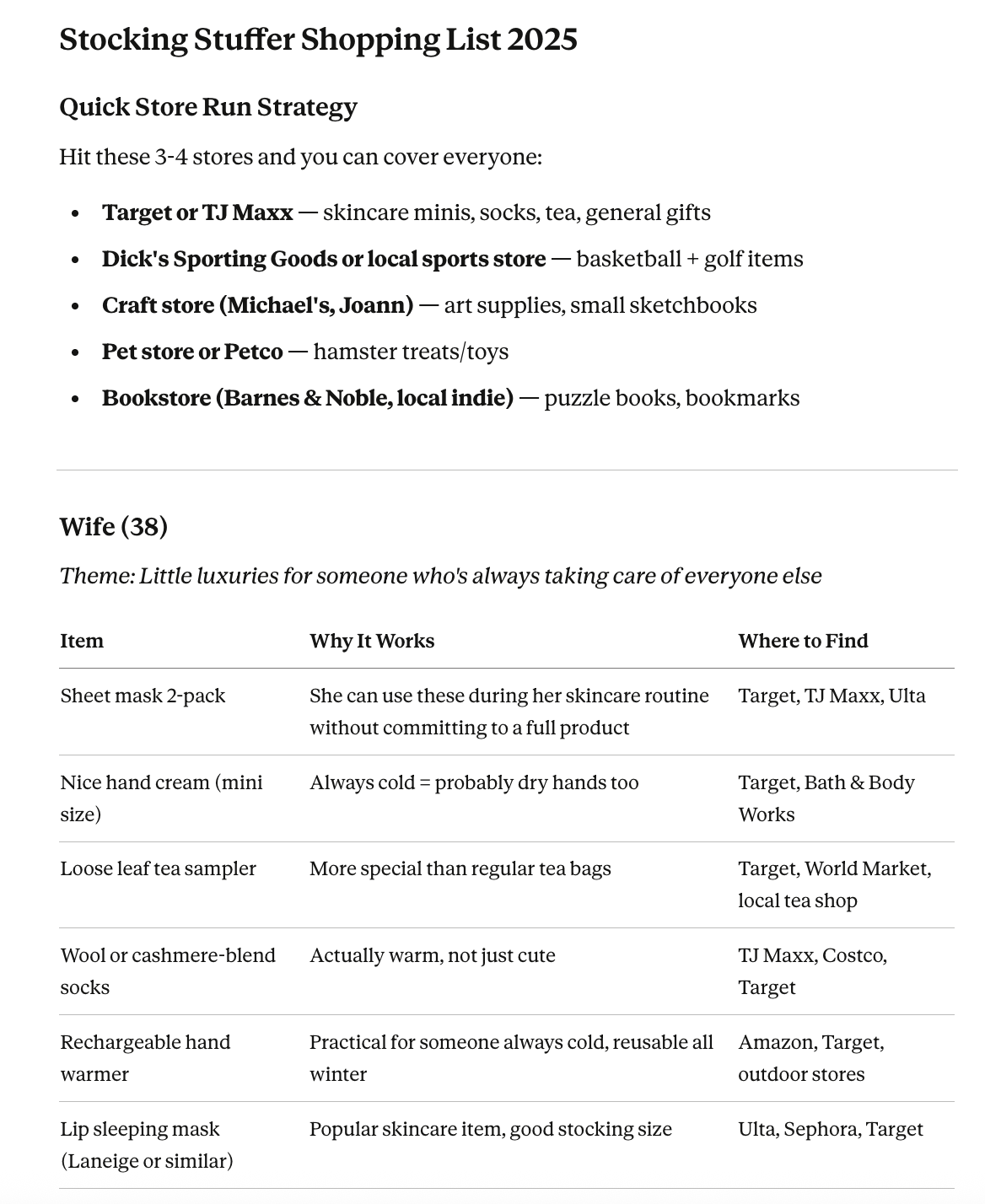
Anthropic's "Thoughtful Gift Giving with Claude" resource illustrates how the company is packaging its Claude assistant around everyday, emotionally resonant use cases rather than purely technical or professional workflows. The piece walks through a holiday-shopping scenario—filling stockings for five family members with distinct personalities and constraints—and shows how Claude can move from vague prompts ("help me think of gifts") to a structured, reasoned shopping list. The example demonstrates Claude synthesizing personal details (a diabetic father, a daughter obsessed with her hamster, a mother who does crossword puzzles) into specific, non-generic suggestions, while also articulating its own reasoning framework: gifts that show attentiveness, upgrade an existing habit, or remove minor daily friction.
The functional core of this use case is Anthropic's push toward "agentic" and multimodal integration rather than standalone chat. The article highlights three optional capabilities that transform Claude from a suggestion engine into a task-completing assistant: web search for real-time product availability and pricing, iOS connectors that let Claude search Notes and iMessages for previously mentioned gift hints, and Claude in Chrome for actually completing purchases and coordinating pickup. This layering—reasoning, memory retrieval, real-world search, and browser-based action—reflects Anthropic's broader strategy of positioning Claude not just as a text generator but as an assistant that can plug into a user's existing digital life and execute multi-step tasks on their behalf.
This matters because it signals how AI companies are trying to make frontier language models feel indispensable in mundane, low-stakes contexts, which is often how mass consumer adoption actually happens. Rather than emphasizing benchmark performance or enterprise integrations, Anthropic is showing Claude solving a universally relatable problem—last-minute, thoughtless gift buying—using techniques (extended thinking for logistics, personalized context prompts, follow-up conversation chains) that double as an implicit tutorial for prompt engineering. The "tricks and tips" section, which coaches users to give specific rather than generic details and to set budgets upfront, is effectively teaching the broader public how to interact more effectively with LLMs, an educational function increasingly common in vendor documentation as adoption widens beyond technical users.
More broadly, this fits into the industry-wide trend of AI assistants absorbing personal-context tools—calendars, messages, notes, browsers—to reduce the "cold start" problem where a model has no memory of user preferences. Competitors like OpenAI's ChatGPT and Google's Gemini have pursued similar integrations (Gmail, Drive, browser extensions), and Anthropic's emphasis on connecting Claude to iMessage and Notes for "forgotten hints" mirrors that same race toward context-aware, action-capable assistants. The gift-giving example is a low-stakes proving ground for capabilities—memory retrieval, real-time search, autonomous purchasing—that Anthropic is simultaneously developing for higher-stakes enterprise and agentic applications, suggesting the company is using consumer lifestyle content partly as accessible marketing for its more ambitious agentic roadmap.
 Read original article →