Detailed Analysis
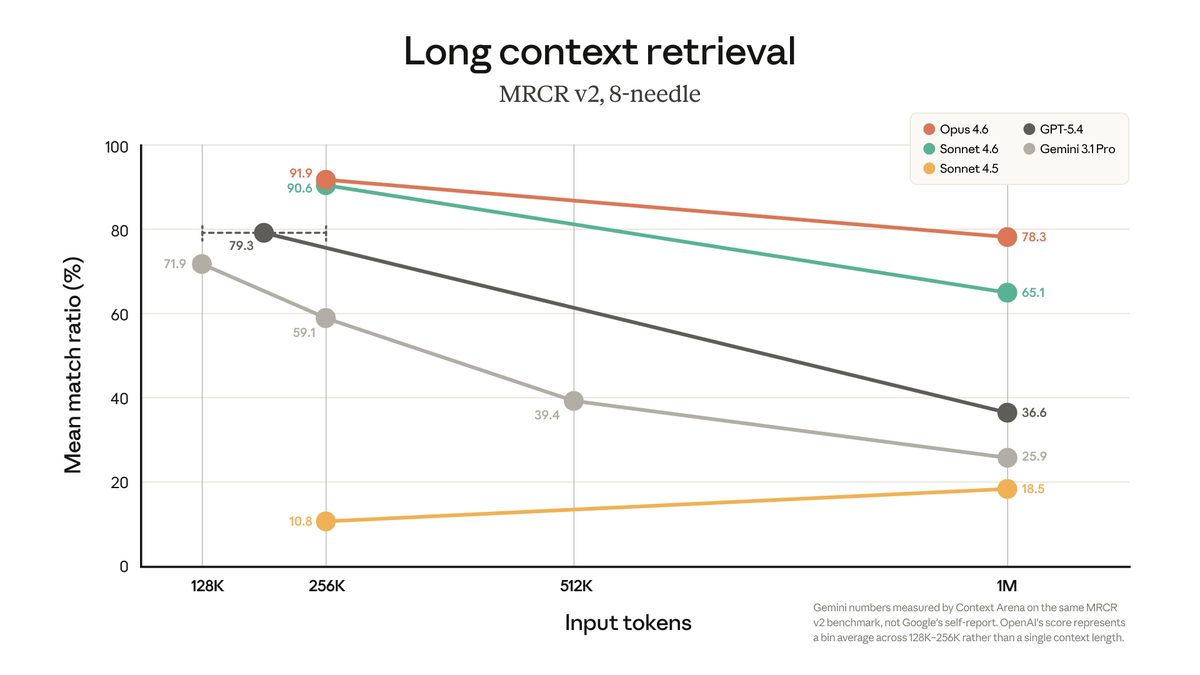
Anthropic has made its 1 million token context window generally available for two of its flagship models, Claude Opus 4.6 and Claude Sonnet 4.6, marking a significant expansion in the practical deployment capabilities of its Claude model family. This milestone moves what was previously a limited or experimental feature into full production availability, meaning developers and enterprises building on Anthropic's API can now reliably leverage the extended context at scale. A 1 million token context window translates roughly to the equivalent of several full-length novels, hundreds of research papers, or entire large codebases being processed in a single prompt — a capability that fundamentally reframes what tasks AI models can perform in a single inference pass.
The significance of this announcement lies not merely in the raw number but in the transition from availability to general availability. Prior to this, extended context windows — even when technically possible — often came with constraints around rate limits, latency, pricing tiers, or beta access requirements that made them impractical for production workloads. By making 1 million token context generally available across both its most capable model (Opus 4.6) and its balanced performance model (Sonnet 4.6), Anthropic is signaling that the infrastructure to support these extremely long contexts has matured sufficiently for enterprise-grade reliability. This is particularly relevant for use cases such as legal document review, financial analysis, large-scale code refactoring, and scientific literature synthesis, where comprehensive in-context information is critical.
The move also reflects the intensifying competition among frontier AI labs around context length as a key product differentiator. Google's Gemini models have similarly emphasized long-context capabilities, with Gemini 1.5 Pro and its successors supporting up to 1 million and even 2 million token windows, pushing the entire industry to treat context length as a first-class feature rather than an edge capability. Anthropic's general availability announcement positions Claude Opus 4.6 and Sonnet 4.6 as direct competitors in this space, particularly for enterprise buyers who require both large context and strong reasoning performance.
Broader trends in AI development suggest that the race to extend context windows reflects a deeper architectural and product philosophy: reducing the need for complex retrieval-augmented generation (RAG) pipelines by allowing models to simply ingest entire document corpora directly. While RAG remains valuable for dynamic or frequently updated knowledge bases, the ability to fit massive static corpora into context simplifies system design and can improve coherence, since the model reasons over all information simultaneously rather than relying on retrieved snippets. Anthropic's decision to make this capability generally available — rather than reserving it for select enterprise partnerships — also aligns with its stated mission of broad and safe deployment of AI, democratizing access to what was until recently a cutting-edge and scarce resource.
 Read original article →