Detailed Analysis
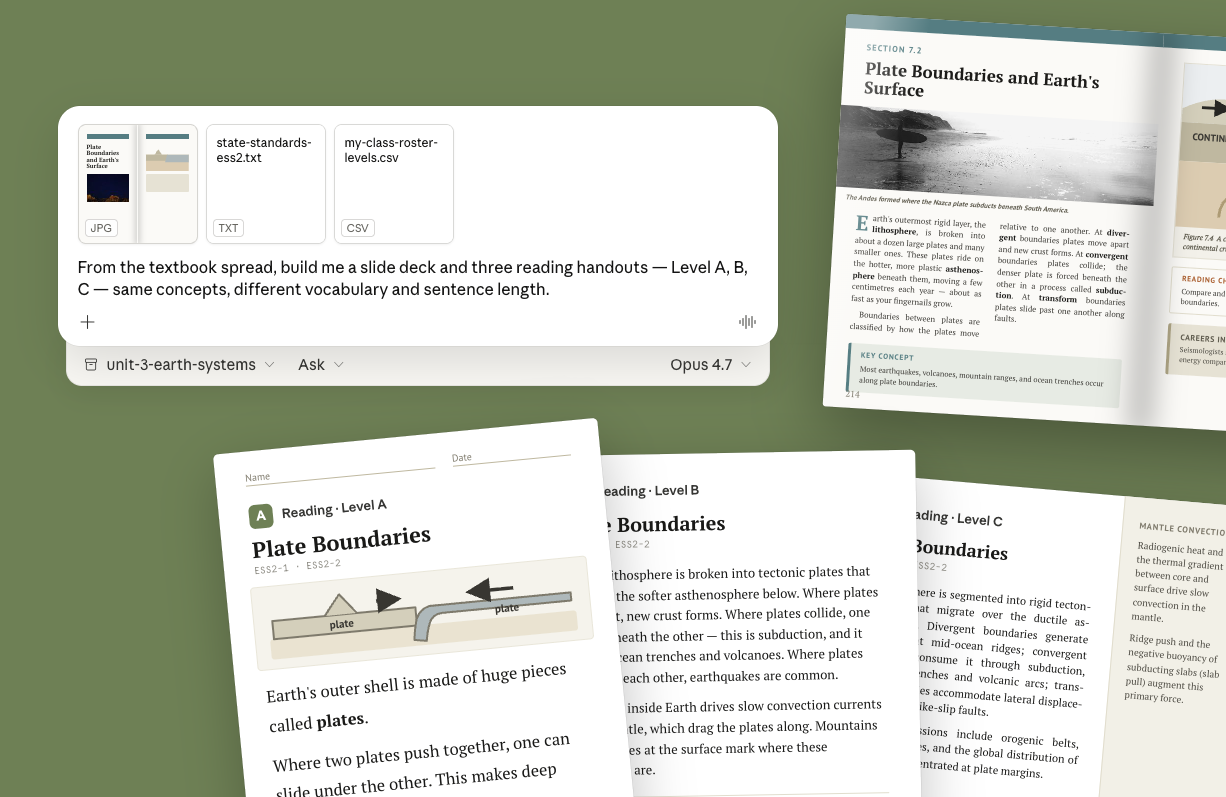
Anthropic's Claude Opus 4.7 positions itself as a comprehensive differentiated instruction engine for educators, capable of ingesting a single photographed or scanned textbook spread and producing a full suite of classroom-ready materials calibrated to distinct learner profiles. The use case, as demonstrated with a plate tectonics chapter, illustrates the model generating a nine-slide presentation deck, three tiered reading handouts (below, at, and above grade level), and a standardized exit-ticket worksheet — all mapped to specific state science standards (ESS2-1 and ESS2-2) and returned as editable .pptx and .docx files. Crucially, Opus 4.7's enhanced visual parsing allows it to reliably read small diagram labels, sidebar text, and captions from a full textbook spread without requiring the teacher to pre-crop or pre-process the image, lowering the practical friction of content ingestion considerably.
The pedagogical logic embedded in this workflow reflects established differentiated instruction principles. By preserving identical core concepts across all three reading levels while modifying only vocabulary complexity and sentence length — for instance, rendering "lithosphere" as "Earth's outer shell" and "subduction" as "one plate slides under another" for Level A — the model honors the curricular integrity demanded by state standards while expanding accessibility. This mirrors the approach advocated by tools like OpenEduCat's AI Text Leveler and Brisk Teaching, which similarly target Lexile measures or grade bands rather than content reduction. The article's explicit mention of what was *excluded* — the textbook's "Careers in Geology" sidebar, judged irrelevant to the named standards — demonstrates a form of standards-alignment reasoning that goes beyond simple text simplification into editorial judgment about curricular relevance.
The integration of Claude's file-output capability ("file creation") is a meaningful functional distinction from earlier generative AI approaches to this problem. Prior tools largely returned adapted text as readable output within a chat interface, requiring teachers to manually reformat the content into usable documents. Returning finished .docx and .pptx files directly removes a significant post-processing step from the educator's workflow, particularly in high-volume contexts where a teacher might need to differentiate materials for an entire unit rather than a single lesson. The article's "Cowork" feature extends this further by allowing a project to read from a folder of lesson pages on a local computer, with standards and version rules persisted in project instructions, reducing repetitive prompting to a single short command per new page.
This use case arrives within a broader competitive landscape where AI-assisted differentiation has become a crowded product category. Brisk Teaching, to-teach.ai, Rewordify, and district-level tools from state education departments all target the same core pain point: the labor intensity of producing multiple versions of the same instructional content. What distinguishes the Claude Opus 4.7 approach is the bundling of multimodal input (image parsing of physical textbook pages), multi-format output (presentation plus word processing files), standards-mapping reasoning, and conversational iteration within a single session. Competing specialized tools generally excel at one dimension — rapid text leveling, Chrome-based in-browser adaptation, or ELL-specific vocabulary scaffolding — but require teachers to orchestrate multiple platforms to achieve what this workflow delivers in a single prompt chain.
The broader significance lies in what this workflow implies about the maturation of large language models as practical production tools rather than drafting assistants. The article's framing — "the files come back more complete and correct on the first pass" with Opus 4.7 compared to earlier models — signals a threshold being crossed from AI-as-collaborator to AI-as-deliverable-producer. For education specifically, where teacher time is acutely constrained and differentiation demands are legally mandated for students with disabilities and English Language Learners, the ability to compress what might be several hours of manual adaptation into a single automated workflow carries significant institutional implications. If these capabilities prove reliable at scale, they could meaningfully shift how districts approach curriculum localization, special education compliance, and multilingual learner support — domains where the gap between instructional intent and practical execution has historically been wide.
 Read original article →