Detailed Analysis
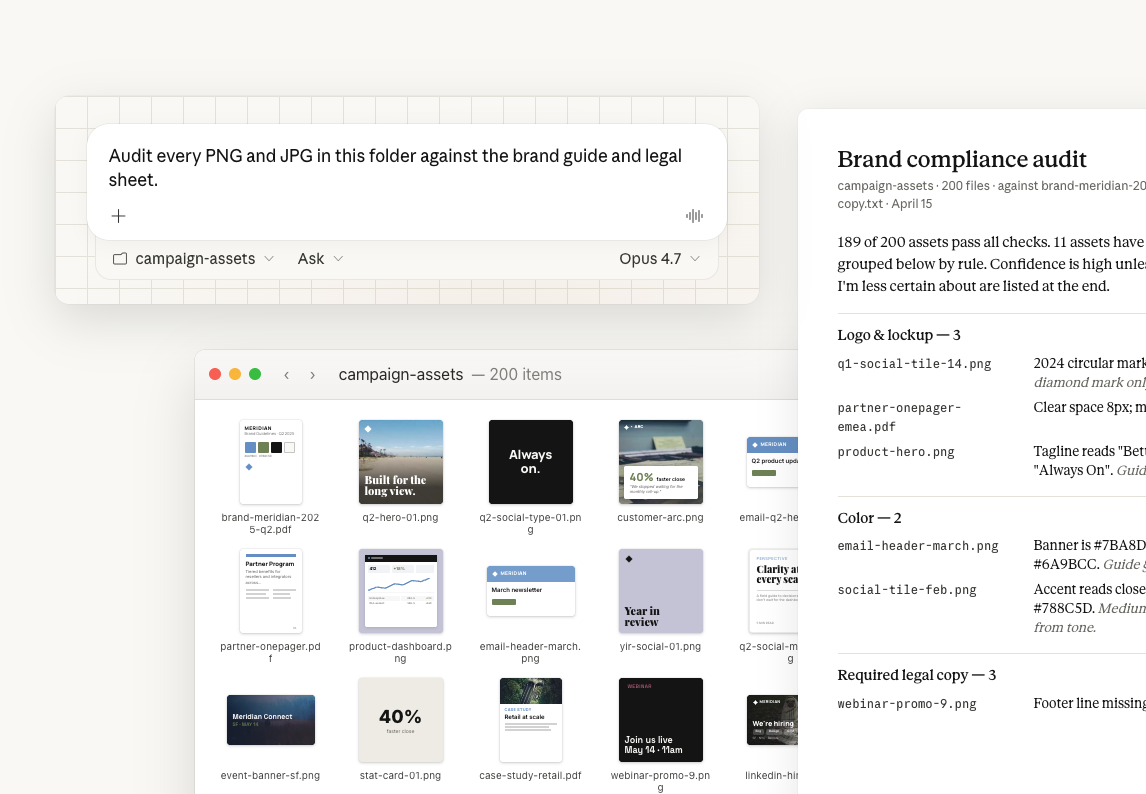
Anthropic's Claude Opus 4.7, deployed within the Claude Cowork environment, introduces a structured visual asset auditing capability that allows organizations to systematically check large folders of marketing and design exports against brand guidelines, legal compliance documents, and style standards. The workflow described enables a user to point Claude at a directory of PNG, JPG, and other file formats alongside reference documents — such as a brand-guidelines PDF and a legal-required-copy text file — and receive back a categorized violation report with per-item confidence ratings. In a demonstration case, Claude audits 200 assets and identifies 11 violations across five categories — logo integrity, color accuracy, typography, required legal copy, and unapproved claims — while confirming 189 assets as fully compliant. The output format is explicitly structured: each violation includes the filename, the nature of the issue, the guideline value, the asset's actual value, and a confidence tier, making the results directly actionable rather than narrative.
The capability is meaningfully differentiated from prior Claude versions by Opus 4.7's improved vision resolution, which allows it to detect fine-grained details that brand compliance inherently depends upon — specific hex codes like #004B9F versus #0052B3, legal copy rendered at 7-point versus 8-point minimum font size, or logo lockup clear-space measured in pixels. These are precisely the details that escape casual human review at scale but carry legal or reputational consequences when published. The integration within Claude Cowork is what operationalizes this at folder scale: rather than processing individual images in isolation, the model holds the full reference document set and the asset library in context simultaneously, enabling consistent rule application across hundreds of files in a single pass.
The broader significance of this use case lies in how it positions AI not as a creative tool but as an enforcement mechanism within existing organizational workflows. Brand governance has historically required either expensive manual review cycles or specialized software with rigid rule sets that cannot interpret contextual nuance — such as distinguishing whether an off-guide green in a regional deck is a violation or an approved regional variant. Claude's ability to flag the latter as "less certain" and surface it for human review reflects a calibrated confidence model that maps closely to how human reviewers actually triage ambiguity. The optional integrations with Asana, Linear, and Slack further embed the audit into established project management and communication pipelines, meaning the output of the AI workflow feeds directly into human task queues rather than terminating in a chat interface.
This development also reflects a maturing pattern in enterprise AI deployment: the combination of a high-capability frontier model (Opus 4.7) with a managed execution environment (Claude Cowork) that provides persistent file access, scheduling, and connector integrations. The ability to save an audit configuration as a reusable skill and schedule it as a recurring Friday task represents a shift from ad hoc AI assistance toward durable, automated governance infrastructure. The research context corroborates this trajectory, noting that brand-auditing skills are available through Claude Code and MCP Market integrations, indicating that Anthropic is building a broader ecosystem of reusable, domain-specific AI workflows on top of its models rather than treating each query as a standalone interaction. For organizations managing large volumes of marketing assets across multiple channels and geographies, this kind of scheduled, confidence-rated brand compliance automation addresses a genuine operational gap that neither manual review nor traditional software has fully solved.
 Read original article →