Detailed Analysis
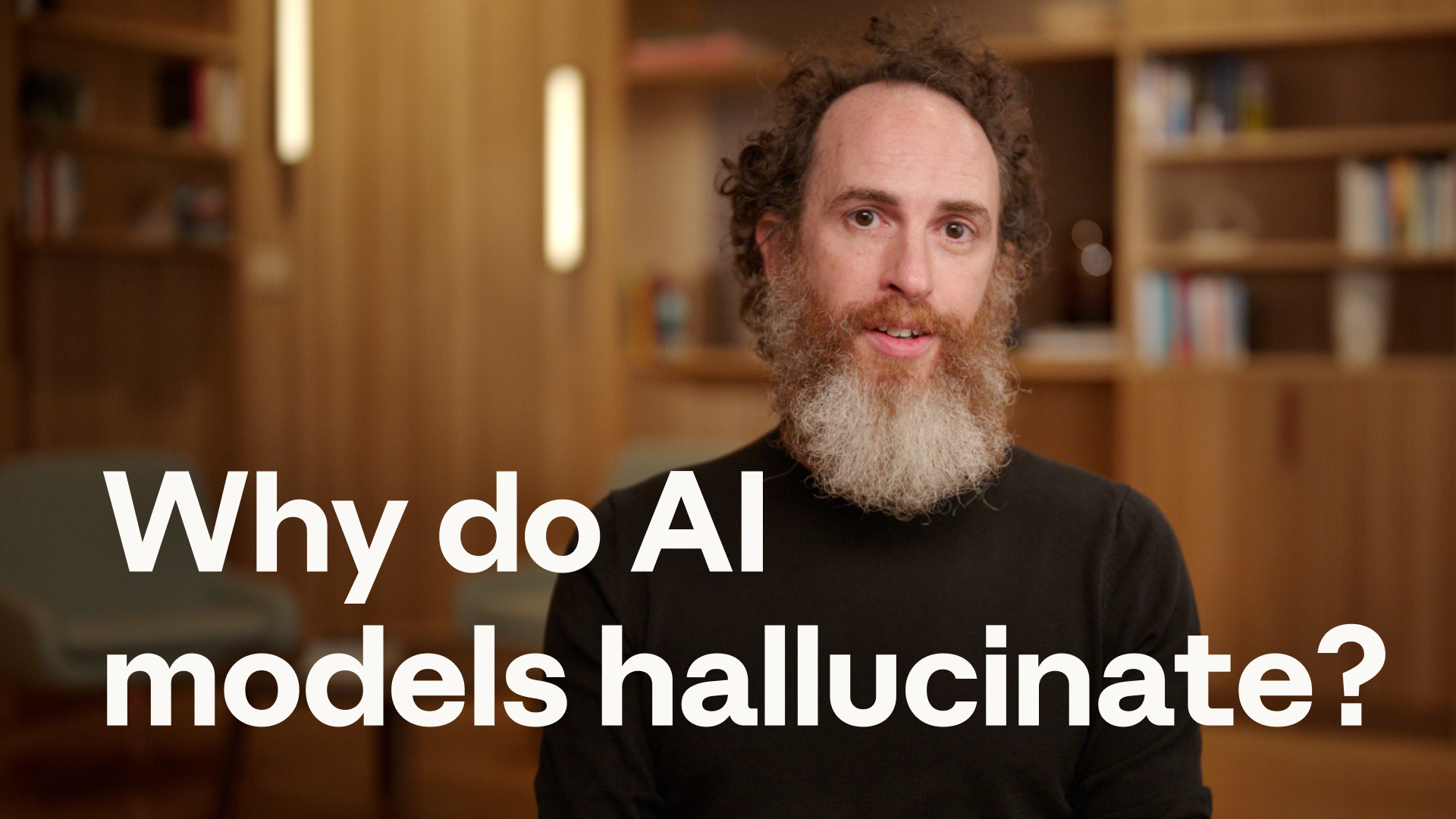
Anthropic's educational resource on AI hallucination, published on Claude's platform as part of its AI fluency initiative, addresses one of the most consequential and widely misunderstood failure modes in modern large language models. Hallucination — the tendency of AI systems to generate outputs that are confident, fluent, and factually wrong — stems primarily from how these models are trained. During pre-training, language models learn to predict the next word in a sequence, an objective that rewards plausibility over accuracy. This incentive structure means that when a model lacks reliable information, it defaults to generating text that sounds correct rather than acknowledging the limits of its knowledge. Compounding this, most evaluation frameworks measure only the percentage of answers that are right, without penalizing confident errors or rewarding appropriate expressions of uncertainty — leaving the guessing behavior intact even after fine-tuning.
Several structural and architectural factors deepen the problem. Training data quality plays a critical role: incomplete, biased, or factually flawed datasets cause models to internalize incorrect patterns, which then surface in their outputs. A model trained on skewed medical imagery, for instance, may misclassify healthy tissue as pathological — not because it is reasoning incorrectly, but because it is faithfully reproducing the patterns it was shown. Separately, language models lack robust mechanisms for grounding their outputs in verified real-world knowledge, which leads to the fabrication of plausible-sounding but nonexistent facts, citations, and URLs. At the architectural level, the sequential, token-by-token generation process means that early errors can compound as a response grows longer, producing cascading hallucinations that drift further from accuracy with each additional sentence.
The significance of this topic extends well beyond technical curiosity. Hallucination is a direct impediment to trust and practical deployment of AI systems in high-stakes domains such as medicine, law, and journalism, where fabricated information can cause real harm. Anthropic's decision to publish this explainer as part of a broader AI fluency curriculum signals a recognition that user education is as important as model improvement. Informed users who understand why hallucinations occur are better equipped to apply verification habits — cross-referencing outputs, recognizing patterns of overconfidence, and understanding when to distrust a model's apparent certainty. This mirrors a broader industry push, reflected in similar educational efforts from Google, IBM, and OpenAI, to close the gap between what AI systems can do and what users assume they can do.
The publication situates itself within a wider, ongoing debate in AI research about whether hallucination is a solvable problem or a fundamental property of current architectures. Researchers have demonstrated that models can be trained to abstain from answering when uncertain, suggesting the behavior is not strictly inevitable. Yet despite significant advances in model scale and sophistication, hallucination rates have proven stubbornly persistent across generations of systems. This reflects a deeper tension in language model design: the same statistical fluency that makes these models useful — their ability to generate coherent, contextually appropriate language — is the same property that enables confident confabulation. Anthropic's framing of hallucination as a learnable, recognizable phenomenon rather than an opaque technical glitch represents a notable stance, one that places responsibility on both the model developer and the end user to manage the limitations of the technology in tandem.
 Read original article →