Detailed Analysis
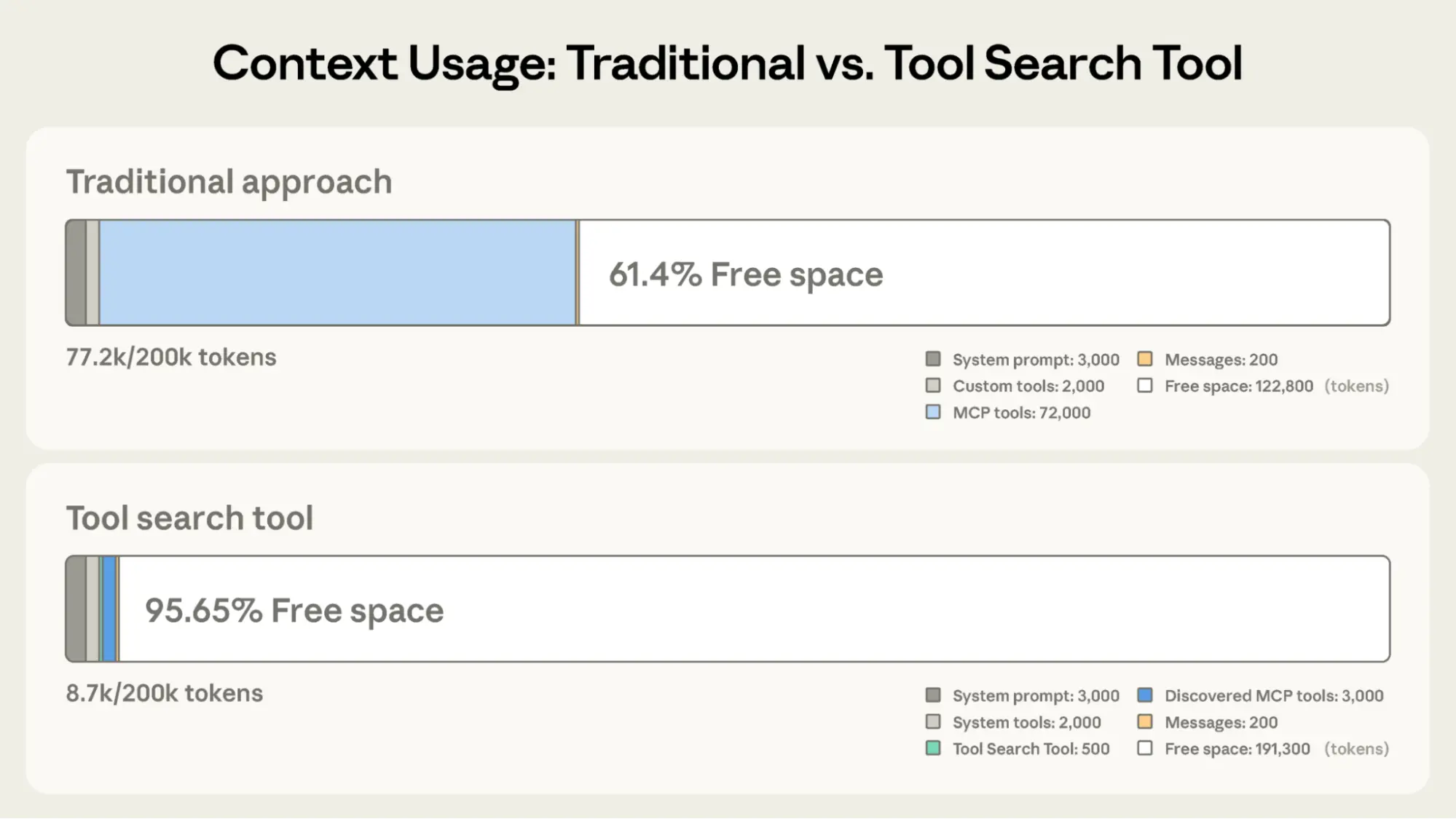
Anthropic's Claude Developer Platform has introduced three significant capabilities — Tool Search Tool, Programmatic Tool Calling, and Tool Use Examples — designed to fundamentally expand what AI agents can accomplish when working across large, complex tool ecosystems. The centerpiece of the release is the Tool Search Tool, which addresses a critical bottleneck in agentic AI architectures: the token overhead consumed by loading tool definitions upfront. In documented cases at Anthropic, tool definitions alone consumed 134,000 tokens before any productive work began. The new system allows developers to mark tools with a `defer_loading: true` flag, meaning Claude only loads the Tool Search Tool itself at the start of a session and retrieves specific tool definitions on demand. Internal benchmarks show this reduces token consumption by approximately 85% — from roughly 77,000 tokens to 8,700 — while preserving 191,300 tokens of usable context compared to 122,800 under the traditional approach.
The accuracy implications of this shift are substantial. Beyond token economy, the release addresses one of the most persistent failure modes in tool-enabled AI systems: incorrect tool selection and parameter misuse, particularly when tools share similar names or overlapping functionality across multiple MCP servers. By surfacing only the 3-5 most relevant tools for a given task rather than exposing all 50-plus simultaneously, the model operates with sharper contextual focus. This effect was measurable in internal evaluations: Claude Opus 4 improved from 49% to 74% accuracy on MCP evaluations with Tool Search Tool enabled, while Opus 4.5 improved from 79.5% to 88.1%. Importantly, the implementation preserves prompt caching functionality since deferred tools are excluded from the initial prompt entirely.
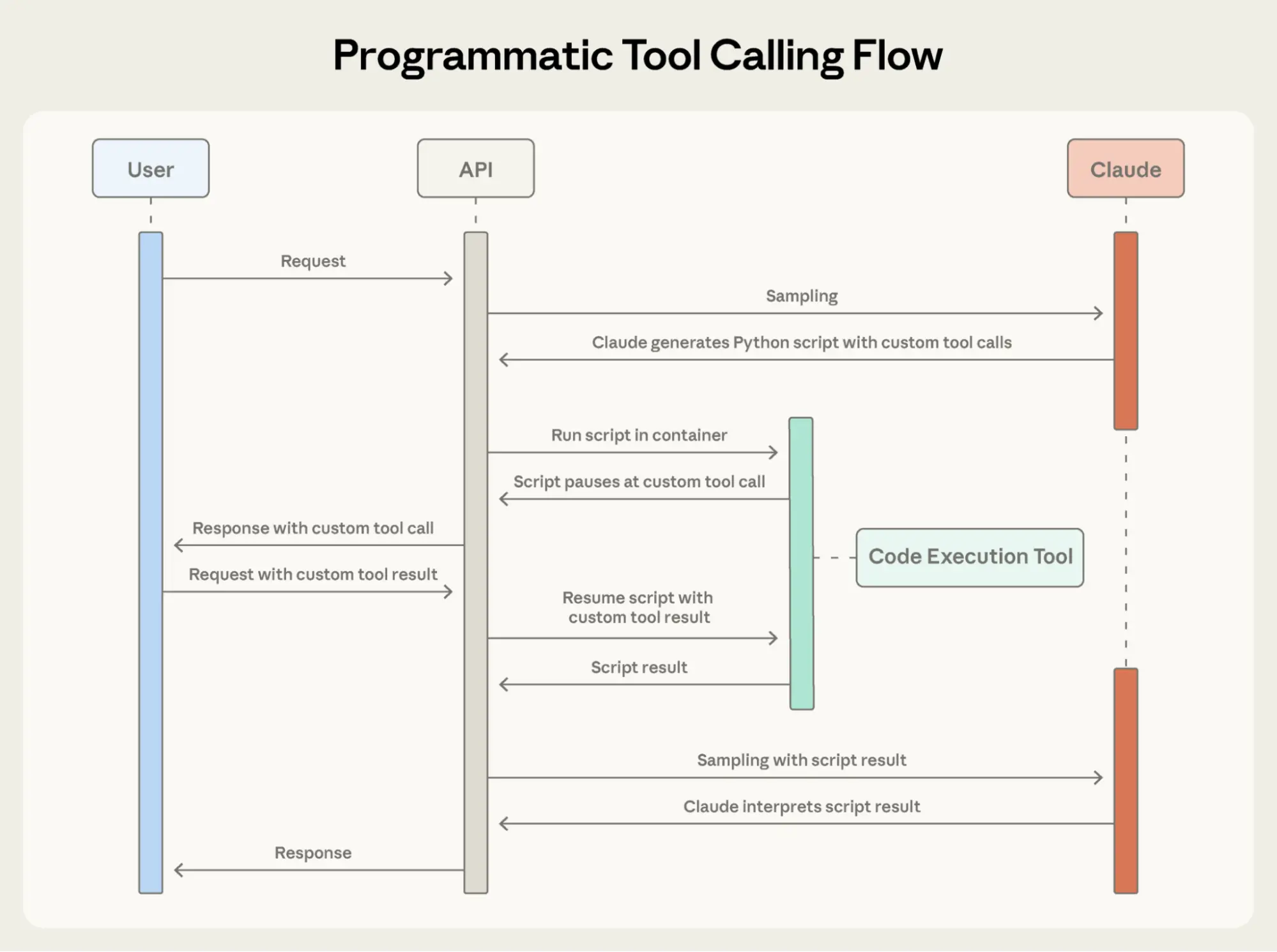
Programmatic Tool Calling addresses a separate but equally consequential constraint in agentic design. Under conventional natural language tool calling, every tool invocation requires a full inference pass, and intermediate results accumulate in the context window regardless of their downstream relevance. By enabling Claude to invoke tools directly within a code execution environment, the new approach leverages code's native strengths — loops, conditionals, data transformations — without burdening the context with intermediary inference outputs. The practical payoff is demonstrated by Claude for Excel, where Programmatic Tool Calling enables reading and modifying spreadsheets containing thousands of rows without overwhelming the model's working context. This points toward a broader architectural principle: hybrid agents that switch between code execution and inference dynamically, based on the structural demands of the task.
The third feature, Tool Use Examples, addresses a subtler but persistent gap in tool integration design. JSON schemas define syntactic validity but cannot communicate pragmatic usage patterns — which optional parameters matter in which conditions, which parameter combinations are idiomatic, or what API conventions a particular service expects. By establishing a universal standard for embedding usage examples alongside tool definitions, Anthropic gives developers a mechanism to transfer behavioral knowledge rather than just structural constraints. This is particularly valuable in enterprise and multi-team environments where tool libraries evolve independently of the agents consuming them, and where tribal knowledge about correct usage patterns is otherwise difficult to encode.
Taken together, these three features signal a deliberate architectural philosophy at Anthropic: agents should be built for scale and composability from the ground up, not retrofitted to handle complexity as an afterthought. The combination of on-demand tool discovery, code-native orchestration, and example-driven tool learning maps directly onto the demands of the agentic scenarios the industry is increasingly prioritizing — multi-server coordination, long-horizon task execution, and integration across heterogeneous enterprise systems. As the broader AI ecosystem converges on MCP as a standard for tool interoperability, the ability to connect hundreds or thousands of tools without degrading model performance or accuracy becomes a competitive differentiator, and this release positions Claude's developer platform to meet that bar.
 Read original article →