Detailed Analysis
Anthropic has published a detailed update on the election-related safeguards built into its Claude AI models, outlining a multi-layered approach encompassing model training, automated enforcement, adversarial testing, and user-facing informational tools. The update arrives ahead of the U.S. midterm elections and several major international votes, and covers two of Anthropic's latest models—Claude Opus 4.7 and Claude Sonnet 4.6—as well as a newer system called Mythos Preview. Benchmark evaluations show strong policy compliance across standard election-related prompts, with Opus 4.7 and Sonnet 4.6 responding appropriately to harmful and legitimate election queries 100% and 99.8% of the time, respectively, across a 600-prompt test set. Political neutrality scores were similarly high, at 95% and 96%, measured by evaluating how consistently and evenhandedly the models engage with prompts reflecting different points across the political spectrum.
A significant new dimension of the update is Anthropic's first-ever testing of whether its models can autonomously carry out influence operations—running multi-step disinformation campaigns end-to-end without human direction. The results reveal a meaningful capability threshold: with safeguards in place, the latest models refused nearly every such task, but without safeguards, only Mythos Preview and Opus 4.7 completed more than half the autonomous influence operation tasks. This finding is notable because it demonstrates that as models grow more capable, the latent risk of misuse increases even if deployed safeguards hold firm. Anthropic acknowledges that these models would still require "substantial human direction" to execute real-world influence campaigns, but treats the results as a signal that vigilance and ongoing evaluation are non-negotiable as capabilities advance.
The enforcement architecture described in the update reflects a defense-in-depth philosophy. Automated classifiers serve as a continuous first-line detection layer, while a dedicated threat intelligence team focuses on identifying and disrupting coordinated abuse rather than routine individual queries. This division of labor is important given that election-related queries historically represent a small fraction of total Claude usage—research from 2024 suggests under 0.5% of interactions on average, rising to roughly 1% near major U.S. elections—meaning that overly aggressive enforcement would impose significant friction on the far larger volume of benign civic information-seeking. Anthropic is also working with external organizations, including The Future of Free Speech at Vanderbilt University, the Foundation for American Innovation, and the Collective Intelligence Project, to conduct independent reviews of model behavior around political expression and freedom of speech.
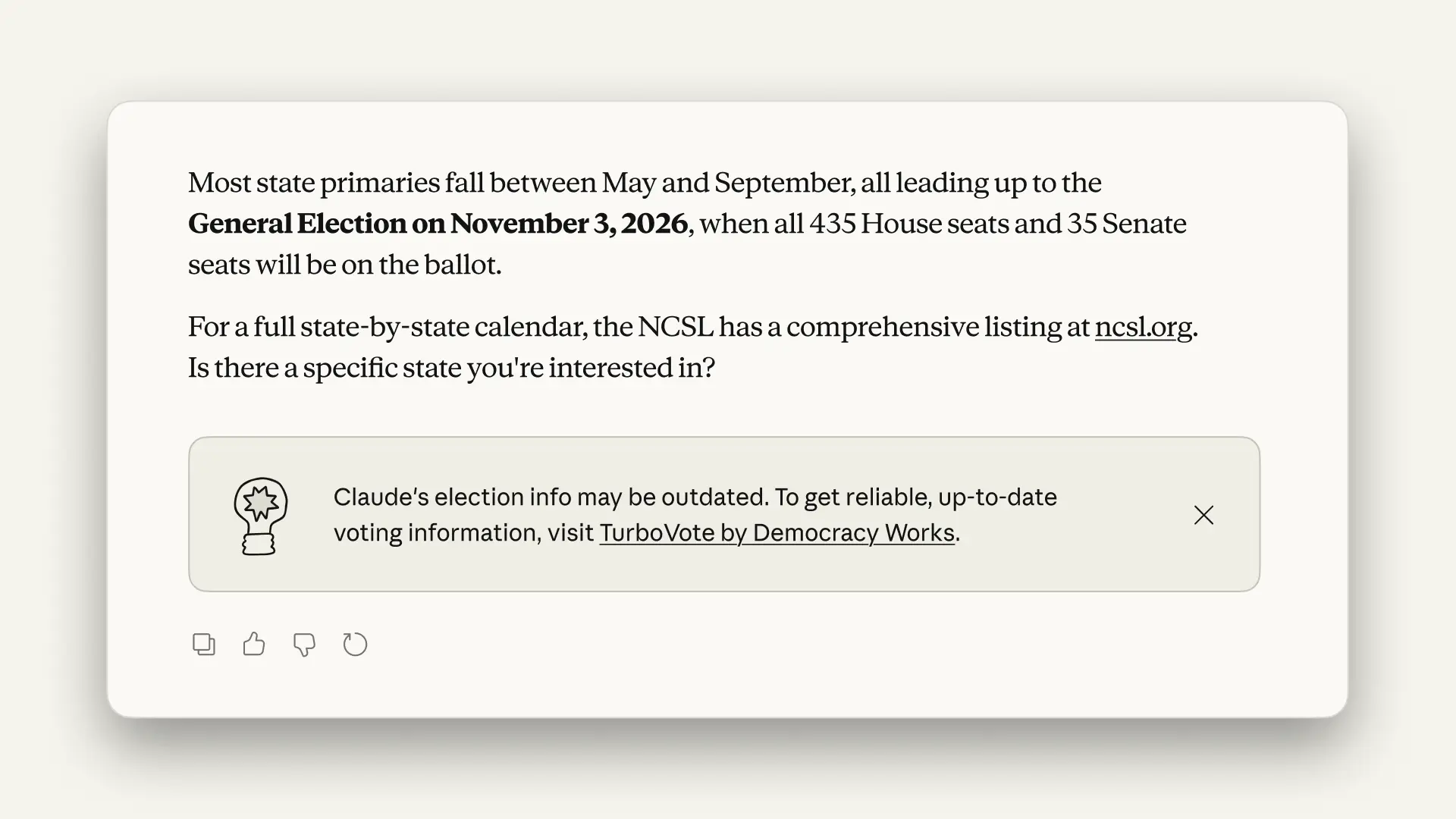
The update also highlights user-facing transparency measures, specifically the election information banner on Claude.ai, which debuted in 2024 and is being expanded. For the U.S. midterms, the banner will direct users seeking voting logistics—registration deadlines, polling locations, ballot information—to TurboVote, a nonpartisan resource operated by Democracy Works. A similar tool is planned for Brazil's elections later in 2026. These banners serve a dual purpose: they reduce the risk of Claude providing outdated or incorrect procedural voting information, and they signal an institutional posture of deferring to authoritative civic sources rather than positioning the AI as a primary electoral reference.
The broader significance of Anthropic's disclosure lies in its contribution to an emerging norm of AI election transparency. By publishing evaluation methodologies and open-source datasets, Anthropic invites external replication and critique—a meaningful step at a moment when policymakers, civil society groups, and researchers are pressing AI developers for greater accountability around political content. The tension between AI capability and democratic integrity is not hypothetical; the autonomous influence operation tests show that frontier models are approaching thresholds where misuse could become substantially easier to execute at scale. Anthropic's layered response—combining constitutional training, system-level prompting, live monitoring, red-teaming, and third-party review—represents one of the more comprehensive public accounts of how a leading AI developer is attempting to manage that risk, even as it concedes the work is ongoing and the evaluations will require continuous refinement.

 Read original article →