Detailed Analysis
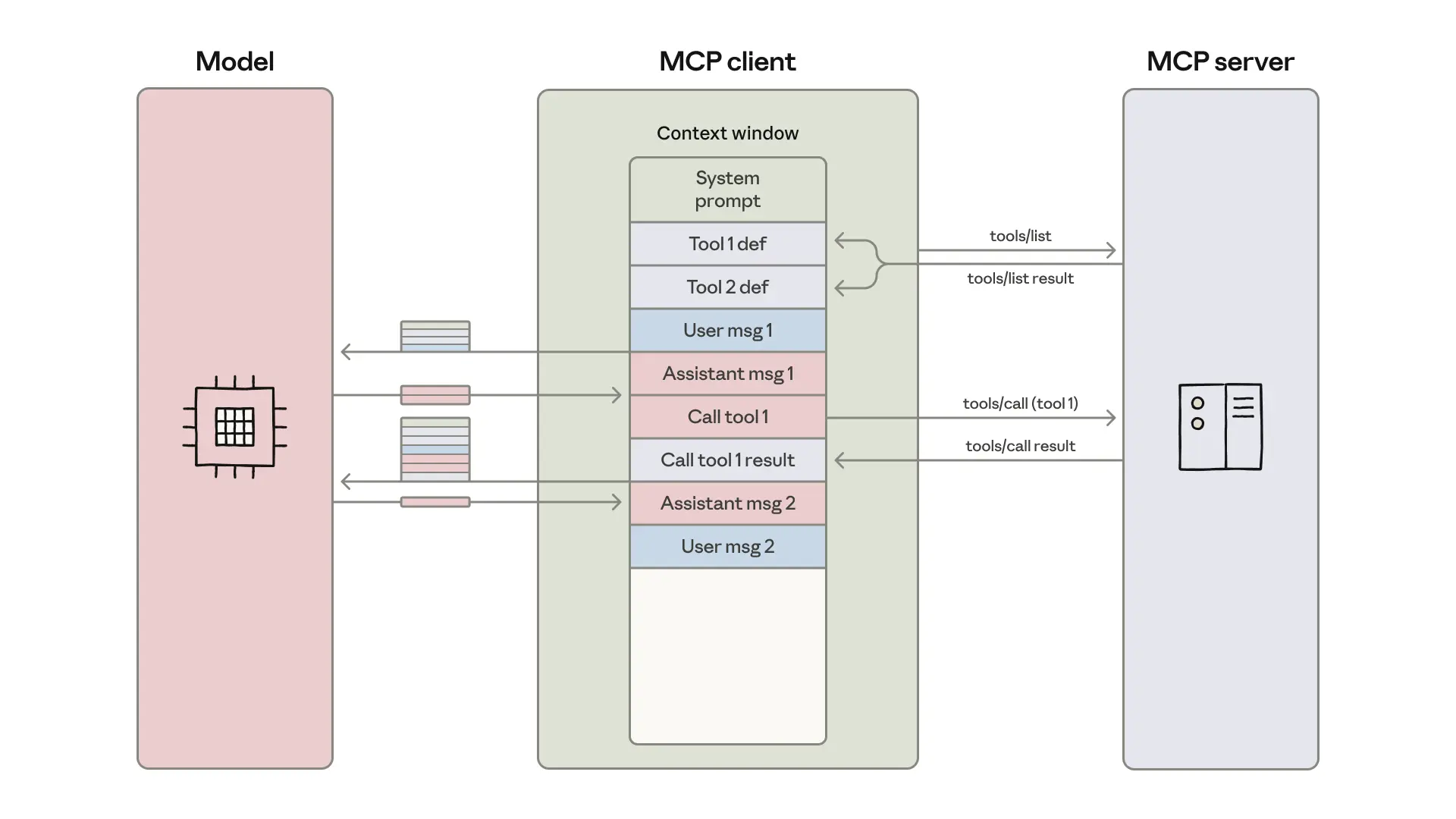
Anthropic's Model Context Protocol (MCP), launched in November 2024 as an open standard for connecting AI agents to external tools and data, has achieved rapid industry adoption — with thousands of community-built servers, multi-language SDKs, and broad recognition as the de facto standard for agent-tool integration. The protocol's core promise is eliminating the fragmentation that arises when developers must build custom integrations for every agent-tool pairing. However, as the article details, the very success of MCP has introduced a new class of scaling problems: agents now routinely connect to hundreds or thousands of tools, and the conventional approach of loading all tool definitions directly into the model's context window — combined with routing every intermediate result through the model — creates significant token bloat that raises cost and latency at scale.
The article identifies two specific failure modes that emerge as MCP deployments grow. First, tool definitions themselves consume substantial context window space; an agent connected to thousands of tools may need to process hundreds of thousands of tokens before it even reads a user request. Second, intermediate results from tool calls must pass through the model context, meaning data is effectively duplicated across sequential operations. The illustrative example — transferring a meeting transcript from Google Drive to a Salesforce record — demonstrates how a single workflow could force a 50,000-token document to traverse the context window twice. Beyond cost, this architectural pattern introduces accuracy risks, as models copying large data structures between calls are more likely to introduce errors, and documents exceeding context window limits can break workflows entirely.
The proposed solution reframes how agents interact with MCP servers: rather than treating tools as direct call primitives loaded wholesale into context, agents are instead given a filesystem representation of available tools and use code execution environments to interact with them programmatically. In the TypeScript implementation described, each MCP tool corresponds to a typed file in a structured directory tree. The agent discovers and reads only the tool definitions relevant to its current task — analogous to importing specific libraries rather than loading an entire standard library into memory. The Google Drive-to-Salesforce workflow, rewritten as a short code block, reduces token consumption from approximately 150,000 tokens to around 2,000, a reported efficiency gain of 98.7%. Cloudflare has independently documented similar findings under the name "Code Mode," lending external validation to the architectural pattern.
This development reflects a broader maturation in how AI agents are designed to handle real-world scale. Early agent architectures assumed a relatively small and static tool surface; as that surface has expanded dramatically, the limitations of context-window-centric designs have become bottlenecks rather than mere inefficiencies. The shift toward code execution as a mediation layer — where the agent writes and runs code that calls tools, rather than having the model directly orchestrate every API interaction — represents a meaningful architectural evolution. It effectively decouples the model's reasoning from raw data throughput, allowing the execution environment to handle data movement while the model focuses on higher-order logic.
More broadly, the pattern described in the article illustrates how open standards like MCP can generate their own second-order engineering challenges. The protocol succeeded in standardizing connectivity, but that success created pressure to rethink how models consume the connectivity it enables. The emergence of code execution as an efficiency layer atop MCP suggests that future agent infrastructure will increasingly involve layered abstractions — protocols for connectivity, execution environments for data handling, and models focused on reasoning — rather than monolithic designs in which the model mediates all operations directly. This architectural direction has implications for how developers structure agent systems, how MCP server authors document and expose their tools, and how the broader industry thinks about the relationship between language model context and computational infrastructure.
 Read original article →