Detailed Analysis
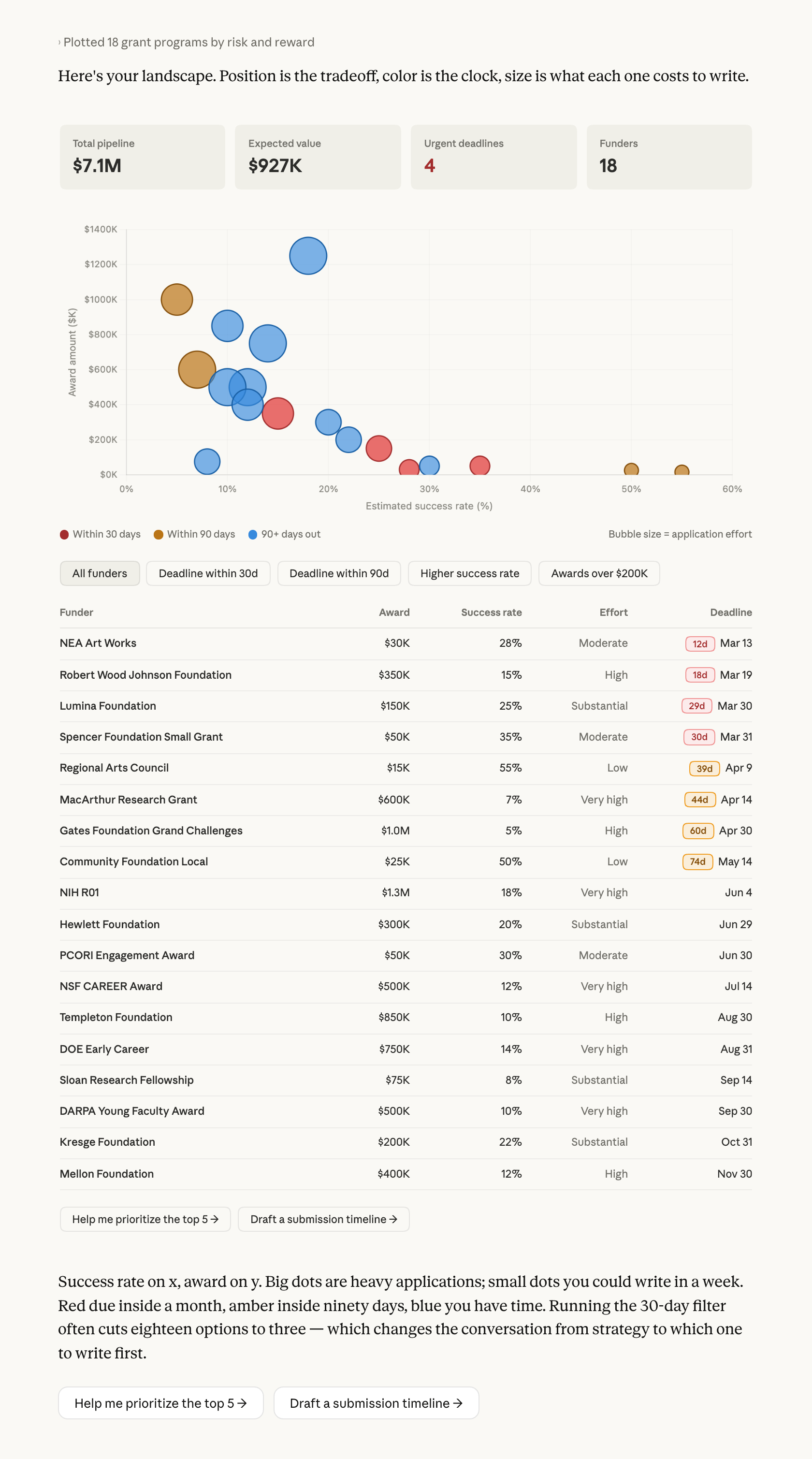
Anthropic's Claude platform has introduced a grant-planning use case that enables researchers and academics to navigate complex funding decisions through an interactive, multi-dimensional visualization built directly within a chat conversation. Rather than forcing users to sort spreadsheet columns one at a time — each view revealing one variable while obscuring others — Claude synthesizes four data dimensions simultaneously: award amount, success probability, deadline proximity, and estimated effort. The result is a risk-reward scatter plot in which long-shot, high-value grants cluster in one spatial region and reliable, lower-stakes awards cluster in another, with the strategic tension between them made immediately legible at a glance. An expected-value card surfaces a single realism-adjusted number, and the gap between that figure and the raw total of all potential awards serves as a quantitative indicator of how lottery-dependent a given pipeline actually is.
The feature is designed around a progressive disclosure model that rewards continued conversation. Users can click individual data points on the chart to expand full grant profiles — deadlines, page limits, competitiveness criteria — without losing the broader visual context. From the same interface, Claude can generate a week-by-week submission timeline by working backwards from each deadline, or redraw the chart entirely after a status change, such as marking a submitted application as in-progress and re-ranking the remaining opportunities. The system is deliberately stateful: saving the chart as an Artifact allows a researcher to return mid-season, incorporate a newly announced RFP, and request a re-plot without rebuilding the context from scratch. Optional Google Drive integration further streamlines the workflow by allowing Claude to read grant pipelines directly from live spreadsheets.
The underlying design philosophy reflects a broader trend in AI-assisted decision support: moving beyond simple retrieval or generation tasks toward tools that help users hold multiple competing variables in mind simultaneously. Grant strategy is a domain particularly well suited to this approach, as funding decisions routinely require weighing incommensurable factors — prestige versus probability, effort versus award size, organizational fit versus deadline feasibility — that resist reduction to a single ranking metric. By externalizing this complexity into an interactive visual surface, Claude acts less as an oracle delivering a single recommendation and more as a collaborative thinking partner that gives the decision a spatial shape the user can interrogate and revise.
The use case also illustrates Anthropic's ongoing effort to position Claude as a practical professional tool for knowledge workers with domain-specific workflows, rather than a general-purpose chatbot. The explicit acknowledgment that Claude's success-rate estimates are more reliable for major federal mechanisms than for private foundations that do not publish data reflects a commitment to epistemic transparency — users are encouraged to treat the visualization as a strategic framework that sharpens thinking rather than a definitive data source that replaces primary verification. This calibration of user trust is increasingly important as AI tools are embedded into high-stakes workflows where a misread probability estimate could mean misallocating months of research effort.
More broadly, the grant-planning tool exemplifies the shift in frontier AI applications from single-turn question answering toward persistent, session-aware workspaces that evolve alongside a user's real-world activities. The emphasis on mid-season return visits, incremental updates, and deadline-driven scheduling suggests that Anthropic is actively designing for the temporal rhythms of professional practice — a recognition that genuinely useful AI assistance must integrate into ongoing processes rather than simply respond to isolated queries. This positions Claude not merely as a productivity accelerator but as an infrastructure layer for complex, multi-week knowledge work.
 Read original article →