Detailed Analysis
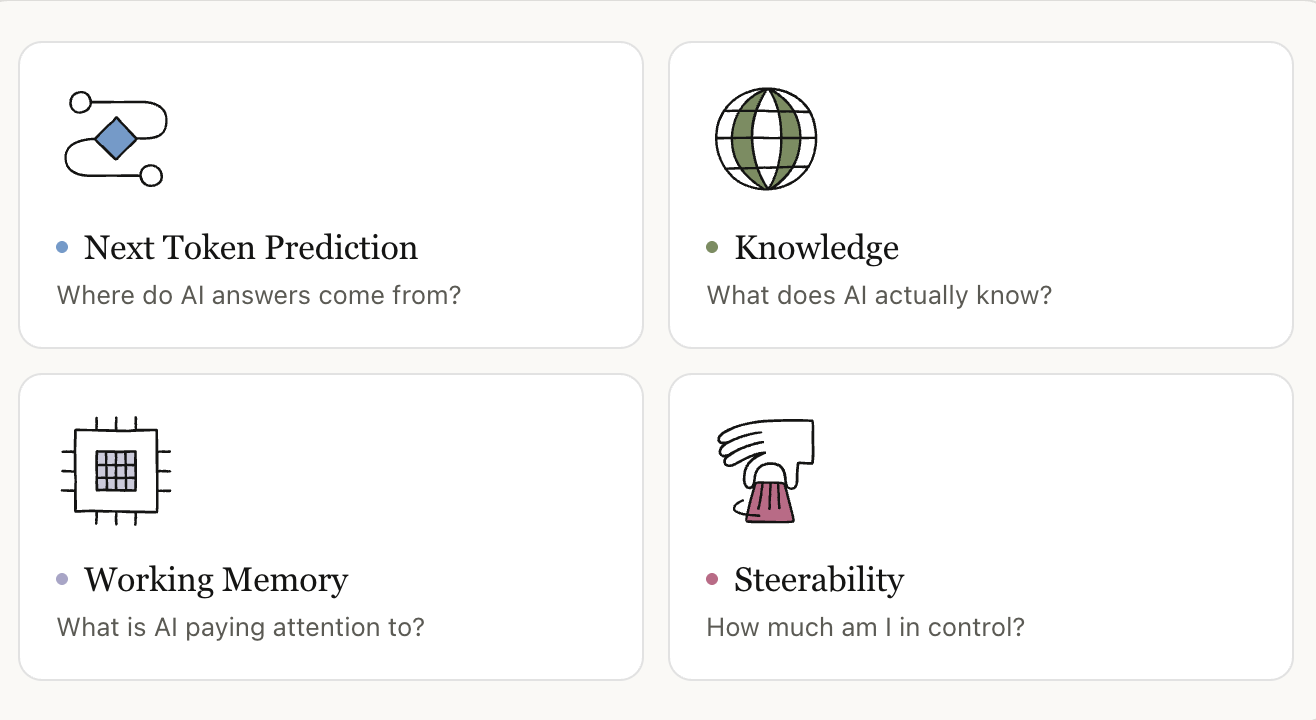
Anthropic's educational resource "The 4 Properties of AI," published through Claude's official tutorial platform, presents a structured framework for understanding the fundamental capabilities and limitations of generative AI systems. The tutorial organizes AI behavior around four core properties: next token prediction, knowledge, working memory, and steerability. Each property is examined through a consistent analytical lens that covers what it enables, where it characteristically fails, and which Claude-specific features exist to extend its practical limits. The framework is notable for its candor — it explicitly names failure modes such as hallucination, confabulation, knowledge cutoff staleness, and prompt injection rather than minimizing them, positioning the resource as a tool for realistic AI literacy rather than promotional messaging.
The next token prediction property grounds the entire framework by explaining that generative AI is, at its core, a highly sophisticated autocomplete mechanism rather than a search engine or a reasoning system in the traditional sense. This distinction matters enormously for understanding why AI can produce fluent, confident-sounding text that is nonetheless factually wrong. The knowledge property addresses the training data cutoff problem, acknowledging that model knowledge is frozen at a specific point in time and is unevenly distributed across domains — a limitation Claude partially addresses through web search, retrieval-augmented generation, and tool use for real-time data access. Together, these two properties explain the majority of AI hallucination incidents that users encounter in practice.
The working memory and steerability properties address the interactive and operational dimensions of AI use. The context window is framed not as a seamless capability but as a resource with a hard ceiling — a "cliff, not a gradient" — with the additional complication that information buried in the middle of long contexts receives less reliable attention. Claude's memory features, Projects functionality, and context compaction are presented as mechanisms to manage these constraints. Steerability, meanwhile, is treated with similar nuance: the model follows instructions by pattern continuation rather than genuine intent comprehension, which enables precise control over format and tone but also creates failure modes like reasoning drift over long task chains and the "letter-over-spirit" problem where instructions are technically honored but their underlying purpose is missed.
The resource situates itself within Anthropic's broader educational initiative, Anthropic Academy, directing users toward a full AI Capabilities and Limitations course that builds on the same four-property framework with hands-on exercises and videos. This reflects a growing industry-wide recognition that raw AI deployment without user education produces poor outcomes. Anthropic's decision to publish this framework under Claude's own branding signals a deliberate transparency strategy — one that acknowledges AI limitations as features of the product's honest self-presentation rather than liabilities to be obscured. The explicit naming of prompt injection as a steerability failure mode is particularly significant, as it touches on AI security concerns that have broad implications for enterprise deployment and agentic AI systems where models operate with greater autonomy.
The four-property framework connects to broader trends in AI interpretability and responsible deployment. As AI systems become more deeply embedded in professional workflows, the gap between what users believe AI can do and what it actually does has become a primary source of downstream harm — including legal, medical, and journalistic errors stemming from uncritical reliance on AI-generated content. Anthropic's taxonomy provides a vocabulary for diagnosing AI failures by property type rather than treating all errors as equivalent, which is a meaningful contribution to AI literacy infrastructure. The pairing of each limitation with specific Claude features designed to mitigate it also reflects the competitive reality that AI providers are increasingly differentiating themselves not just on raw capability benchmarks but on the sophistication of their mitigation architectures around known failure modes.
 Read original article →