Detailed Analysis
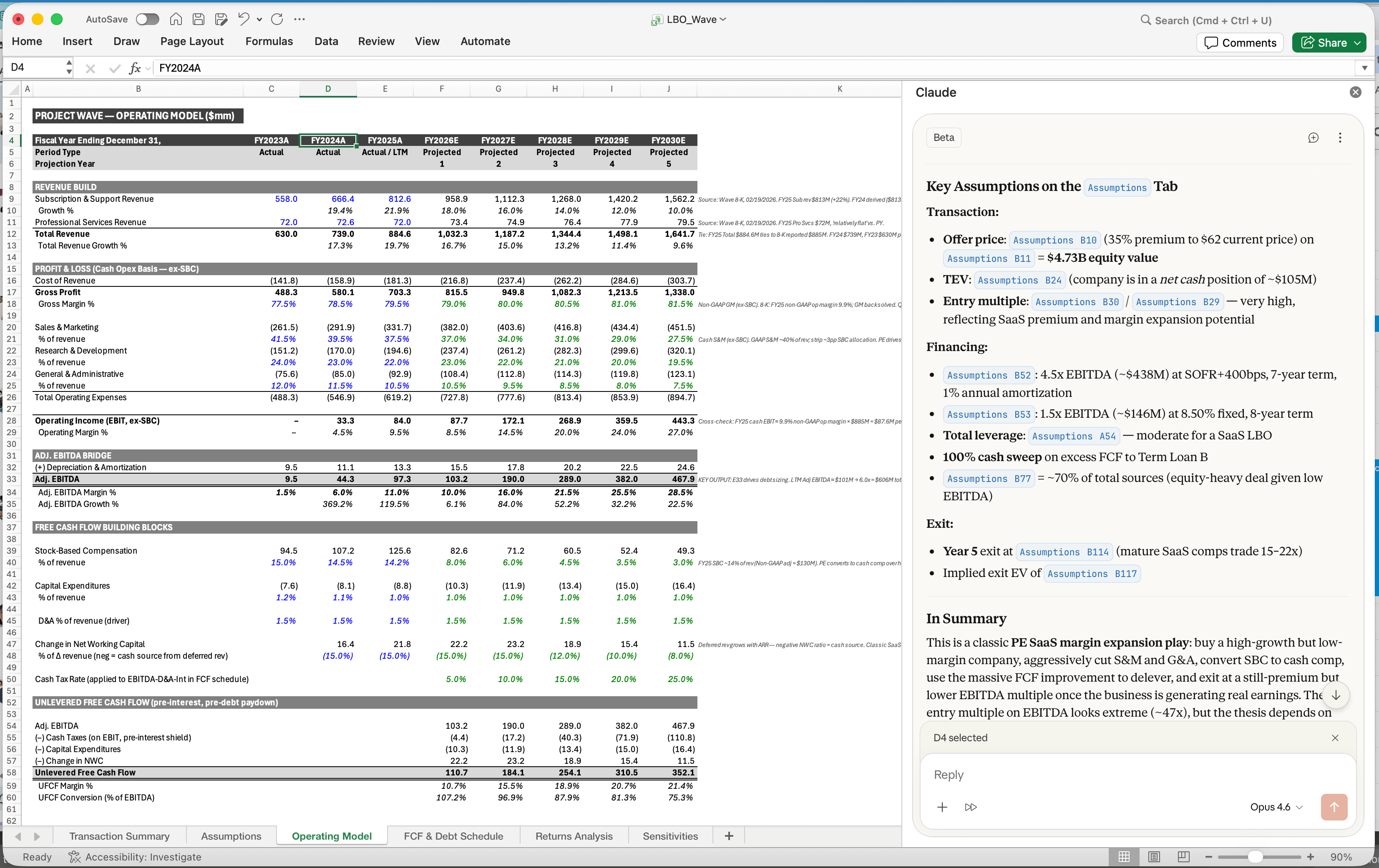
Anthropic's Claude has been integrated into a multi-tool financial workflow designed to accelerate the post-earnings analysis process for portfolio managers and analysts. The workflow, described on Claude's official use-case resource page, connects Claude's capabilities across three distinct environments — Cowork, Claude for Excel, and Claude for PowerPoint — to handle the full loop from earnings data ingestion to slide deck production. The system leverages an S&P Global connector to pull earnings releases and call transcripts directly, then cross-references that live data against an analyst's existing financial model stored in an attached folder. The result is a structured brief identifying where forecasts diverged from actuals and which forward-looking model assumptions lack support from management commentary on the earnings call.
The workflow is notable for its context persistence across tools. When an analyst completes a Cowork session and moves into Claude for Excel to make cell-level changes, the conversation thread carries forward. Upon opening Claude for PowerPoint, the system already has awareness of which cells were modified and why, eliminating the need for the analyst to re-explain the thesis or the print before building the investor deck. The example provided in the article illustrates this concretely: a hypothetical company, ACME, beats revenue estimates by $130 million and reports gross margin of 45.7% against a modeled 42.4%, with Claude flagging a single critical assumption — the FY28 gross margin estimate in cell Assumptions!C7 — as unsupported by management guidance, since the CFO explicitly declined to speak to out-year margin durability beyond 2027.
The design philosophy embedded in this workflow reflects a deliberate division of labor between AI capability and human judgment. Claude handles the mechanical and data-intensive tasks — pulling documents, identifying discrepancies, cross-referencing transcripts against model cells, and flagging unsupported assumptions — while the analyst retains full authority over which changes to accept and what investment conclusions to draw. The article's repeated emphasis on reviewing flags "before anything changes" and the instruction to "make the call on what moves" underscores that the system is positioned as a decision-support tool rather than an autonomous one, consistent with Anthropic's broader framing of Claude as an assistant that augments rather than replaces professional judgment.
This use case sits within a broader trend of AI systems being embedded directly into domain-specific professional workflows rather than operating as standalone chat interfaces. The integration of Claude with S&P Global data infrastructure, Excel, and PowerPoint reflects a productization strategy that meets financial professionals inside the tools they already use, reducing the friction of AI adoption in high-stakes analytical environments. The optional Financial Analysis plugin — which adds DCF, comparable company, and LBO modeling capabilities — suggests a modular architecture where core functionality can be extended for more complex deal or valuation work, further aligning the product with the needs of investment banking and asset management professionals who operate across multiple analytical frameworks simultaneously.
The post-earnings use case is also strategically well-chosen as a demonstration of Claude's applied utility because it involves a recurring, time-sensitive, high-stakes workflow with a consistent structure. Earnings season compresses the time between data release and client-facing communication to hours, making speed and accuracy particularly valuable. By enabling the workflow to be saved as a reusable "skill," Anthropic is positioning Claude not just as a one-time assistant but as a persistent, institutionalized part of the quarterly analytical cycle — a compounding value proposition that deepens integration into professional practice over time.


 Read original article →