Detailed Analysis
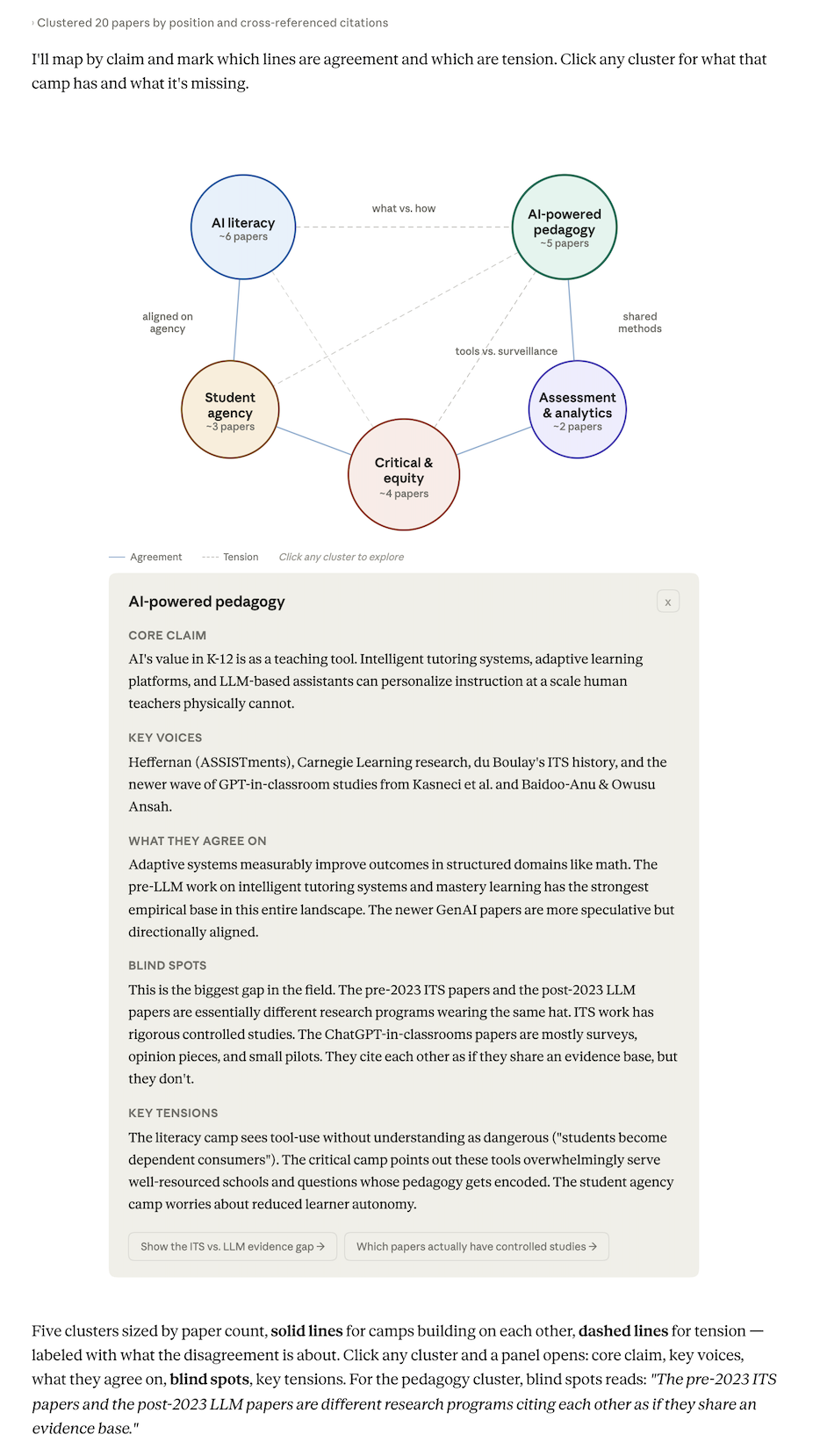
Anthropic's Claude offers a specialized capability for academic researchers struggling with the cognitive challenge of synthesizing large bodies of scholarly literature — generating structured, visual argument maps mid-conversation that organize papers by intellectual camp rather than by topic or keyword. The feature is designed for a specific and well-documented pain point in graduate-level research: after reading a dozen or more papers, the cumulative shape of a debate becomes difficult to hold in working memory. Claude addresses this by clustering papers according to the claims they advance, drawing tension lines between camps that disagree, and generating "blind-spot panels" for each cluster that surface what a given scholarly faction consistently undertheorizes. The article illustrates this with a concrete scenario: a graduate student who has read twenty papers on AI in K-12 education and can no longer distinguish which papers are building on one another from which are simply talking past each other.
The analytical value proposition rests on a key distinction Claude's documentation emphasizes: clustering by argument rather than by subject matter. A topic-based organization would group papers by theme — assessment, equity, teacher training — while an argument-based map reveals that papers on the same topic may belong to opposing intellectual camps. This is precisely the information a researcher needs when trying to identify the genuine fault lines in a literature and locate their own contribution within it. The blind-spot sections add a further layer of analytical utility: they represent Claude's inference about what each camp takes for granted or fails to interrogate, which the article notes is "the kind of thing you stop seeing once you're inside a literature." This framing positions the AI not as an authority on the field but as an outside reader capable of noticing assumptions that have become invisible to practitioners embedded in the discourse.
The feature's design reflects a broader philosophy in Anthropic's product development around Claude as a collaborative intellectual tool rather than an answer-delivery mechanism. The map is explicitly framed as "one reading of the debate — something to check against your own," and the follow-up interaction patterns encourage users to push back, reposition individual papers, and correct Claude's clustering. When a user disputes where a paper belongs, the map redraws — and the article notes that the act of disagreeing is itself analytically productive, potentially marking the beginning of the user's own original argument. This dialectical interaction model, in which the AI's interpretation is a starting point for the human's reasoning rather than a conclusion, aligns with emerging norms around AI-assisted knowledge work that seek to augment rather than replace expert judgment.
The integration with Google Drive and Claude's Projects feature points to a practical concern about the temporal dimension of literature reviews, which often span weeks or months. By keeping source documents persistently available across conversations, researchers can incrementally update the map as they encounter new papers without re-uploading existing materials — a workflow accommodation that acknowledges how literature reviews actually unfold in practice. The ability to export the map as an Artifact and continue iterating on it, or to ask Claude to draft a "state of the debate" section directly from the clusters, further compresses the distance between synthesis and writing. These capabilities position Claude within the broader trend of AI systems being embedded into professional workflows at the level of task-specific cognitive labor, rather than serving as standalone query-response tools, a trajectory that is reshaping research, legal, and analytical professions across industries.

 Read original article →