Detailed Analysis
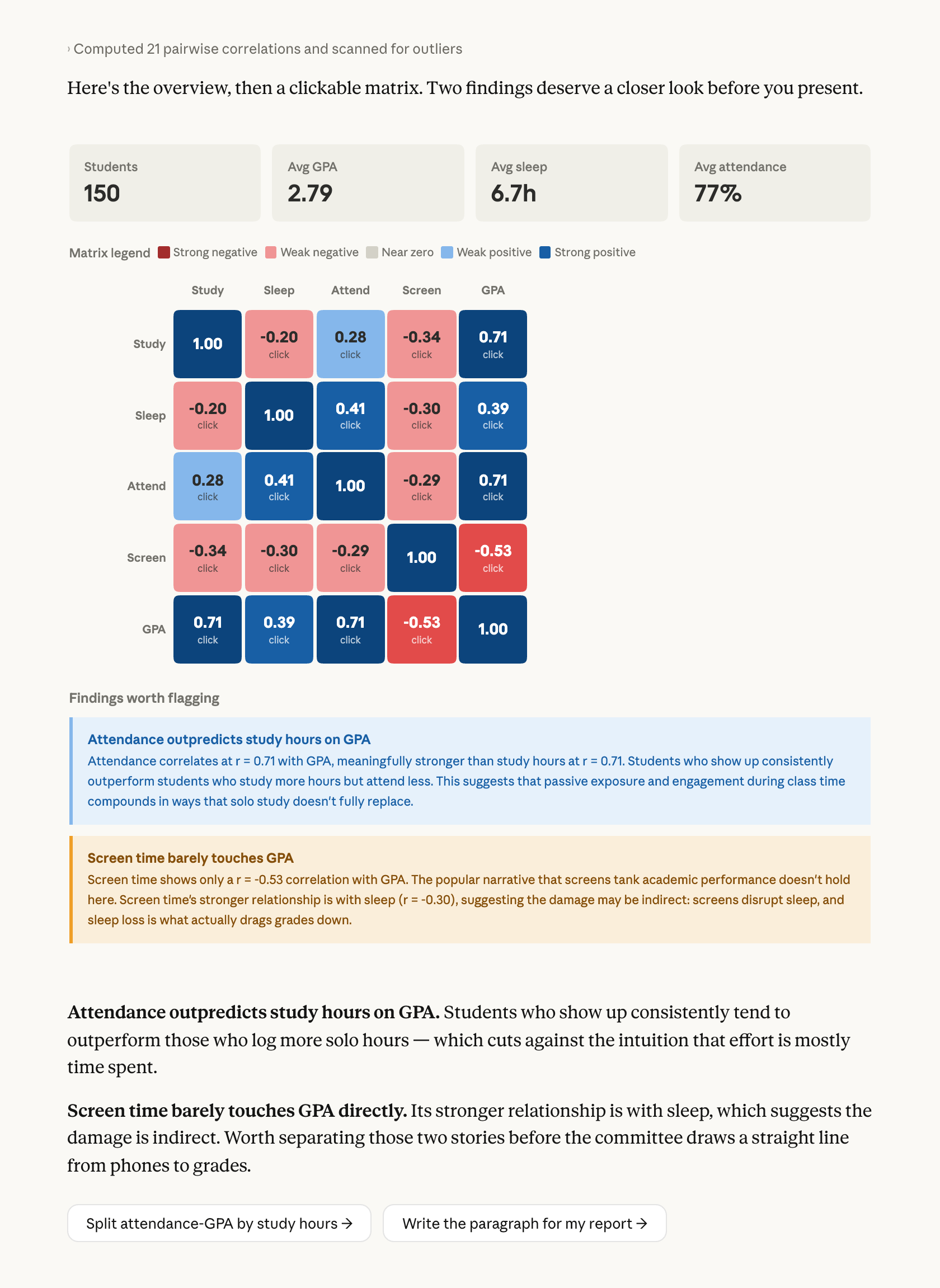
Anthropic's Claude platform has introduced an interactive data exploration workflow that allows users to upload CSV files and generate clickable correlation matrices directly within a conversational interface, enabling exploratory data analysis before committing to any formal interpretation. The feature, highlighted through a use case involving a researcher analyzing survey data on study habits and GPA, lets Claude construct a full correlation grid inline, flag statistically or contextually surprising relationships, and expand individual cell pairs into scatter plots on demand — all without leaving the conversation thread. The integration with Google Drive further extends this capability by allowing Claude to read data directly from Google Sheets, reducing friction in the upload-and-analyze workflow.
The design philosophy behind this feature centers on interpretive collaboration rather than passive chart generation. Two specific prompt elements — asking Claude to "flag anything that surprises you" and specifying the audience (a committee presentation) — demonstrate how natural language instructions meaningfully shape the output. The first directive invites Claude to layer analytical judgment on top of visualization, surfacing cells that cut against expected narratives. The second calibrates the readability and labeling of output to match the stakes of the setting. This reflects a broader pattern in how Anthropic is positioning Claude: not merely as a tool that executes instructions, but as an analytical interlocutor that brings its own read to data while deferring final interpretive authority to the human user.
The feature's built-in epistemic safeguards are notable. Anthropic explicitly acknowledges within the use case documentation that a striking correlation can reflect a real relationship, a confound, or a sample quirk — and that the chart itself cannot distinguish between these. This framing positions Claude's flags as hypotheses rather than conclusions, and the follow-up prompts — splitting scatter plots by a third variable, quizzing users on causation versus correlation — are designed to stress-test initial readings before they become formal claims. The "quiz me on the matrix" prompt in particular operationalizes a kind of pre-mortem for analytical overclaiming, which is a meaningful guardrail in research and professional contexts where misread correlations carry reputational or decision-making consequences.
This capability sits within a rapidly expanding frontier of AI-assisted data work, where tools like Claude, ChatGPT with Advanced Data Analysis, and various notebook-integrated AI assistants are competing to own the exploratory phase of quantitative workflows. What distinguishes Anthropic's approach here is the emphasis on the conversational arc: the artifact — the correlation matrix — is treated not as an endpoint but as a shared object that structures ongoing dialogue. The ability to hover, click into pairs, split by variables, and export as interactive artifacts transforms the visualization from a deliverable into a thinking tool. This positions Claude as particularly suited for users who are domain experts in their subject matter but not necessarily fluent in statistical software, enabling them to move from raw data to committee-ready narrative within a single conversation thread.
The broader implication of this workflow is that it accelerates the iteration cycle between data and interpretation in professional and research settings, compressing what might previously have required multiple handoffs between analysts and stakeholders into a single, auditable conversation. As AI models become more capable of handling structured data and generating contextually appropriate visualizations, the competitive differentiator will increasingly be the quality of interpretive guidance layered on top — and Anthropic's decision to build explicit hedging and epistemic humility into the workflow suggests a deliberate bet that trustworthy analysis, not just fast analysis, is the product researchers and practitioners actually need.
 Read original article →