Detailed Analysis
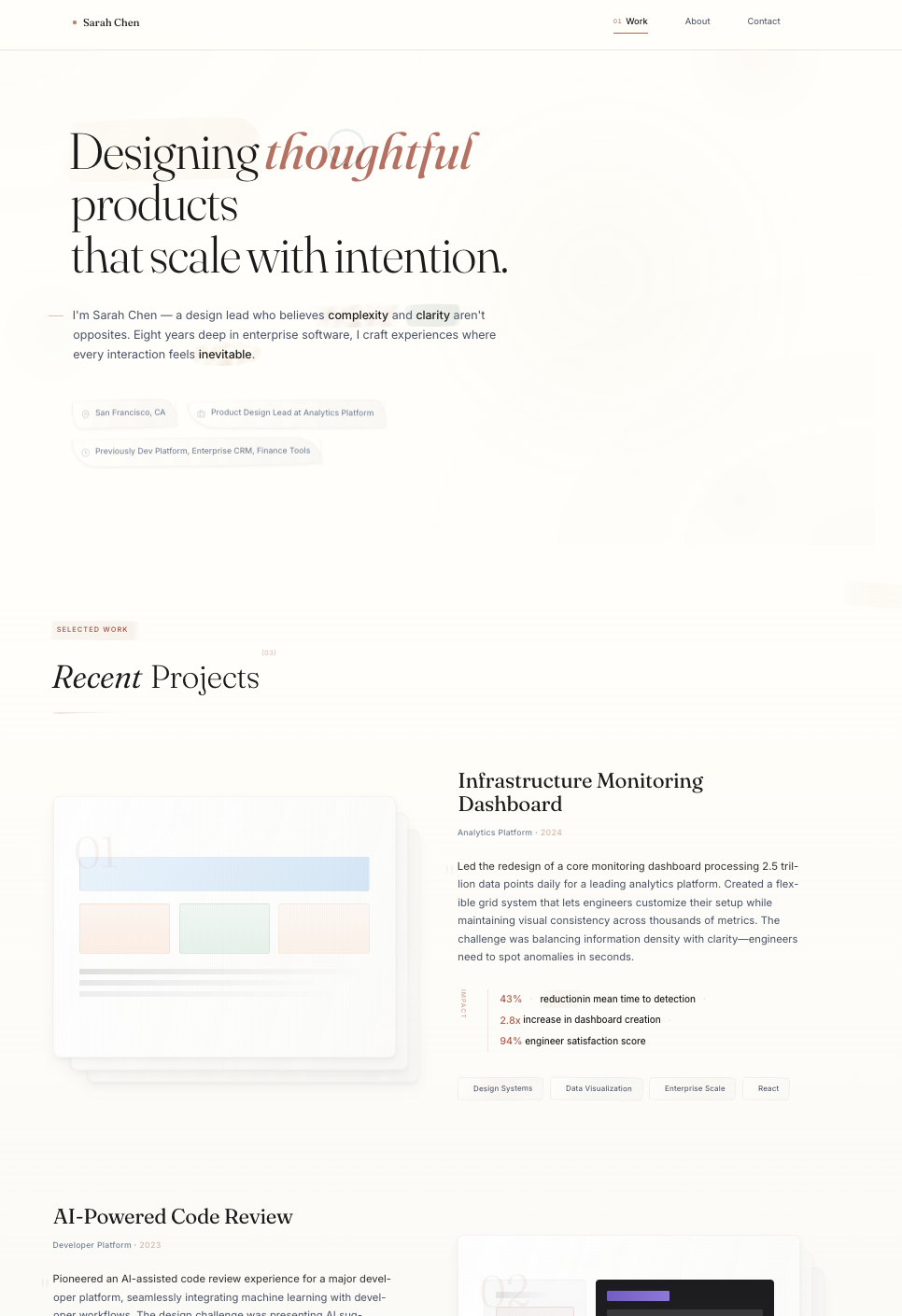
Anthropic's Claude platform offers a guided workflow for building and deploying custom portfolio websites entirely without code, leveraging the model's combined vision and coding capabilities to translate user-uploaded documents and design references into functional HTML artifacts. The process centers on a structured prompting approach: users supply résumés, project descriptions, and aesthetic inspiration files, then direct Claude to synthesize those inputs into a complete, styled single-page portfolio. Claude's output is a self-contained HTML artifact that includes semantic structure, typography choices, animations, and layout decisions informed directly by the uploaded materials. Crucially, the workflow does not stop at code generation — Claude also walks users through live deployment via a Netlify connector integration, handling the technical publishing process and returning a live URL with no manual configuration required on the user's part.
The significance of this capability lies in its compression of what has traditionally been a multi-tool, multi-skill workflow into a single conversational interface. Historically, building and deploying a custom portfolio required proficiency in HTML/CSS, familiarity with version control systems, and working knowledge of hosting platforms. Claude's approach collapses those layers by acting simultaneously as designer, developer, and deployment guide. The inclusion of Extended Thinking as an optional toggle signals that Anthropic views design-quality output as computationally intensive reasoning work — not merely code generation — acknowledging that nuanced aesthetic judgment benefits from deeper inference cycles. The emphasis on avoiding "AI-looking gradients" and generic layouts also reflects a broader industry awareness that AI-generated design has recognizable, often undesirable signatures that sophisticated users actively want to circumvent.
The workflow connects to a broader trend in AI development toward what might be called "end-to-end agentic task completion," where a single model handles not just discrete subtasks but the entire chain from input to real-world deployment. The Netlify connector integration is particularly illustrative: it positions Claude not as a code-generation tool whose outputs must then be taken elsewhere, but as an agent with external tool access capable of pushing artifacts into production environments autonomously. This aligns with Anthropic's documented investment in MCP (Model Context Protocol) tooling and agentic infrastructure, where models are increasingly expected to operate across APIs and services rather than within isolated chat sessions. The portfolio use case is a relatively low-stakes demonstration of this architecture, but it establishes a template applicable to far more complex deployment pipelines.
The article's prompting guidance — recommending quality benchmarks, expert framing, and explicit negative constraints — reveals something instructive about the current state of instruction-following in large language models. Anthropic is effectively coaching users to compensate for known model tendencies toward conservative, functional-but-generic outputs by front-loading stylistic constraint into the prompt itself. The suggestion to use "Skills" — reusable packages of preferences and references — points toward a productization of prompt engineering, where institutional or personal design standards can be encoded once and applied repeatedly without re-explanation. This reflects a maturing understanding that AI outputs are highly sensitive to prompt structure, and that scaffolding that knowledge into reusable artifacts reduces the expertise burden on end users while improving output consistency across sessions.
 Read original article →