Detailed Analysis
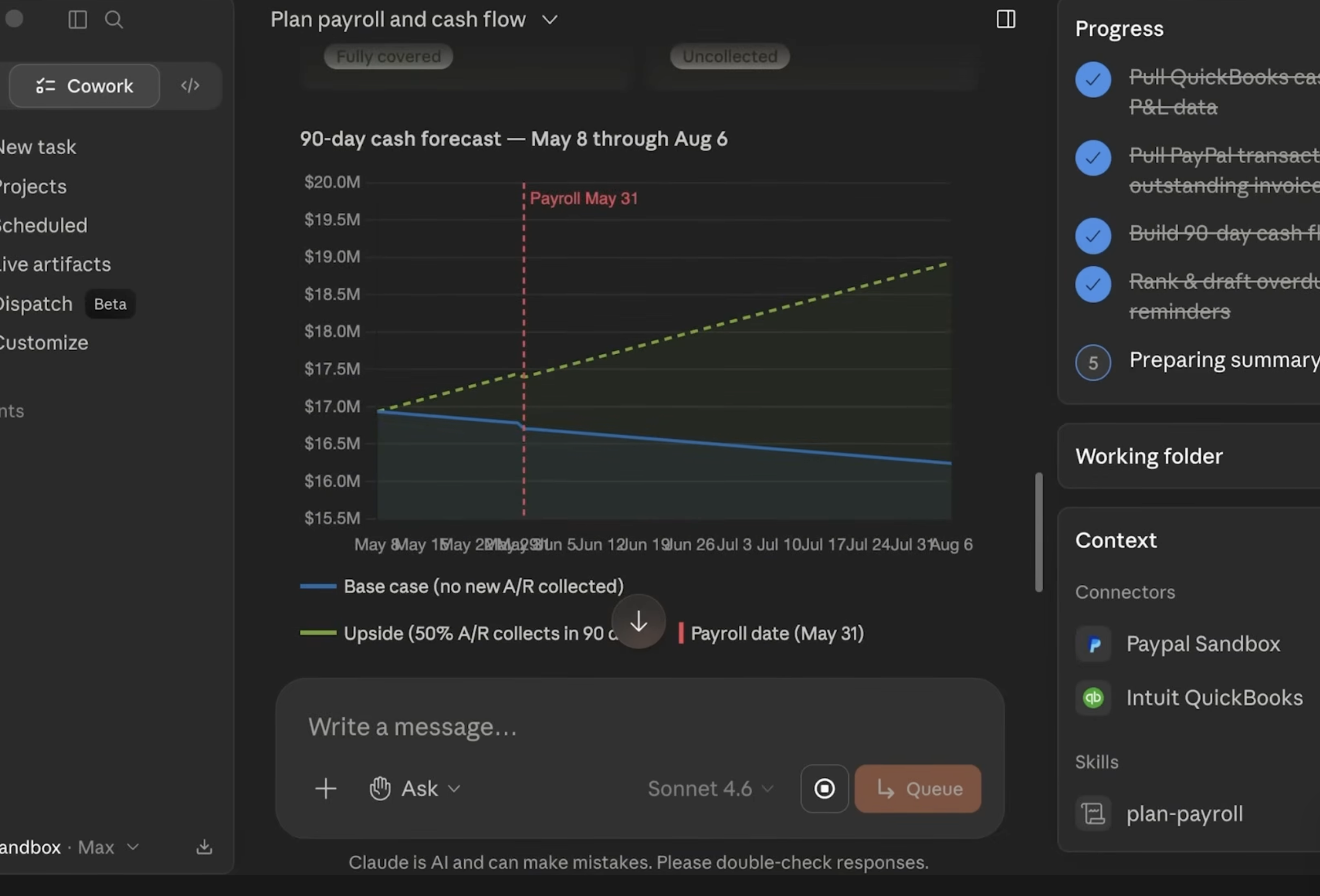
Anthropic has introduced Claude Cowork's Small Business plugin, a workflow automation system that integrates Claude directly with the suite of tools small business owners rely on daily — including QuickBooks, PayPal, HubSpot, Canva, Slack, and calendar and email platforms. The plugin enables four pre-built skill workflows — a Monday morning business brief, a campaign planner, a month-end close process, and a payroll preparation tool — each triggered by a single natural-language prompt. Rather than requiring users to manually pull data from disparate systems, Claude reads across all connected tools simultaneously, synthesizes the information, and delivers structured outputs ranging from reconciliation spreadsheets to staged marketing campaigns and cash-flow forecasts.
The design philosophy underlying each workflow reflects a deliberate human-in-the-loop approach. In the campaign workflow, for example, Claude drafts strategy, generates Canva assets, segments HubSpot contact lists, and stages email drafts — but nothing publishes or sends until the business owner explicitly approves. Similarly, in the month-close workflow, Claude flags discrepancies and prepares the reconciliation packet, but defers final bookkeeping decisions to the owner and their accountant. This pattern of AI preparation followed by human authorization runs consistently across all four skills, addressing a persistent concern about AI agents taking consequential autonomous action in financial and operational contexts.
The small business use case is particularly significant because this segment has historically been underserved by enterprise-grade automation tools, which typically require dedicated IT resources or costly implementation consultants. By embedding multi-step workflows into a conversational interface, Anthropic is effectively democratizing access to the kind of operational intelligence that larger companies deploy through integrated ERP and CRM systems. The Monday brief feature alone — aggregating cash position, payment settlements, CRM pipeline, and calendar into a single weekly digest — represents a workflow that would previously have required custom dashboards or analyst labor to produce consistently.
This launch reflects a broader industry shift toward agentic AI systems that do not merely answer questions but execute multi-tool workflows on behalf of users. Competitors including OpenAI and Google have pursued similar agentic product directions, but Anthropic's framing here emphasizes domain-specific reliability over general-purpose capability — building trust incrementally through constrained, verifiable workflows in a single vertical. The article's repeated emphasis on what Claude reads, what it flags, and what it prepares versus what the human decides signals a positioning strategy oriented around professional accountability, which is especially critical in financial and payroll contexts where errors carry legal and regulatory weight.
 Read original article →