Detailed Analysis
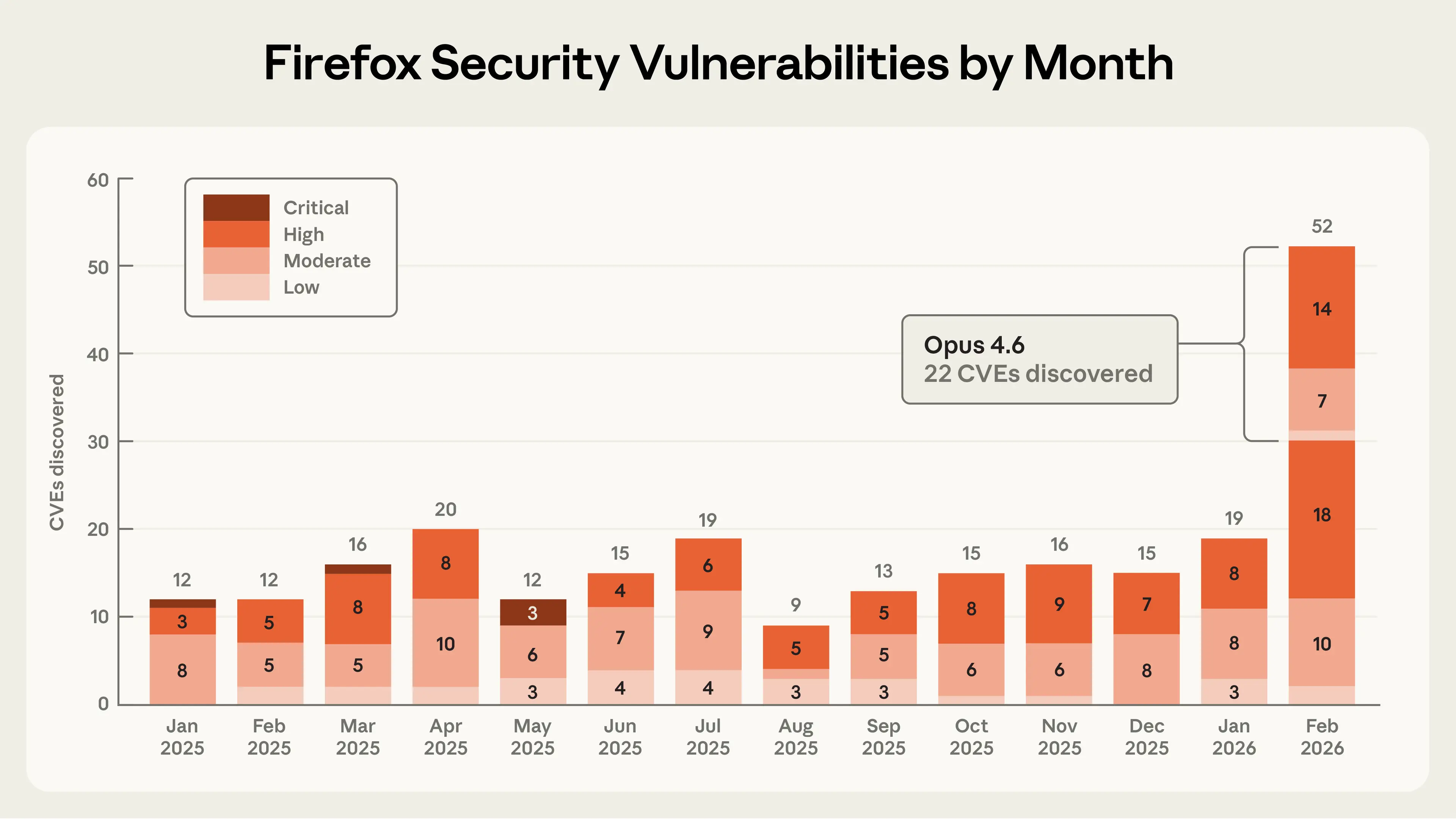
Anthropic's collaboration with Mozilla represents a landmark demonstration of AI-driven cybersecurity research, with Claude Opus 4.6 discovering 22 vulnerabilities in Firefox over a two-week period in February 2026, 14 of which Mozilla classified as high-severity. That figure constitutes nearly one-fifth of all high-severity Firefox vulnerabilities remediated across all of 2025, a striking ratio that underscores the accelerated pace at which AI systems can now surface critical security flaws. The effort began as an internal model evaluation exercise after Anthropic observed that Claude Opus 4.5 was approaching saturation on CyberGym, a benchmark designed to test LLM capability in reproducing known security vulnerabilities. Seeking a harder, more realistic challenge, Anthropic constructed a dataset of prior Firefox CVEs and ultimately pivoted to hunting novel vulnerabilities in the live codebase — bugs that, by definition, could not have appeared in any training data.
The operational results were remarkable in their speed and scale. Claude Opus 4.6 identified its first vulnerability, a Use After Free memory flaw in Firefox's JavaScript engine, within twenty minutes of beginning exploration. By the time the human research team had validated and submitted that first report to Mozilla's Bugzilla tracker, Claude had already generated fifty additional unique crashing inputs. Over the full course of the collaboration, the team scanned nearly 6,000 C++ files and submitted 112 unique reports. The JavaScript engine was chosen as the initial focus due to its discrete analyzability and its outsized security importance — it processes untrusted external code during ordinary web browsing, making it a particularly high-value attack surface. Fixes for the majority of identified issues were shipped to hundreds of millions of Firefox users in version 148.0, demonstrating that the discovery-to-remediation pipeline can function at scale when AI researchers and software maintainers coordinate effectively.
The collaboration also surfaced important lessons about process design at the human-AI interface. Mozilla initially expected individually validated reports, but quickly adjusted its guidance to encourage bulk submission of crash-inducing test cases, even those whose security implications were uncertain. This iterative calibration between Anthropic's research team and Mozilla's triage engineers points to an emerging operational model: AI systems generate findings at a volume and speed that exceeds traditional human-paced validation workflows, requiring maintainers to adapt their intake processes accordingly. Anthropic's candid acknowledgment that false positives remain a risk — and its appreciation for Mozilla's transparency in triage — reflects a mature understanding that AI-assisted security research introduces new error modes alongside its dramatic productivity gains.
Beyond vulnerability discovery, Anthropic extended the evaluation to probe Claude's ability to develop primitive exploits for the bugs it uncovered, seeking to understand the upper boundary of the model's offensive cybersecurity capabilities. This dual-use framing — using the same system to both find and theoretically exploit vulnerabilities — reflects a broader tension in AI security research. Understanding how capable a model is at exploitation is necessary for responsible deployment and safety evaluation, but it also raises questions about the conditions under which such capabilities should be disclosed or constrained. The fact that Anthropic is conducting this research in partnership with a major software maintainer, rather than in isolation, represents a deliberate attempt to embed safety and accountability into the research process itself.
The broader significance of this collaboration lies in what it signals about the trajectory of AI in security engineering. For decades, finding novel vulnerabilities in mature, well-audited codebases like Firefox has required highly specialized human expertise and considerable time investment. Claude Opus 4.6's performance compresses that timeline dramatically, suggesting that AI systems are transitioning from assistants that augment human security researchers to agents that can independently drive significant portions of the vulnerability discovery lifecycle. As AI models continue to advance and are increasingly deployed in agentic configurations with access to real codebases and tooling, the security community — developers, researchers, and maintainers alike — faces both an extraordinary opportunity to harden software at unprecedented scale and a corresponding imperative to establish norms, workflows, and governance structures that ensure these capabilities are channeled responsibly.

 Read original article →